
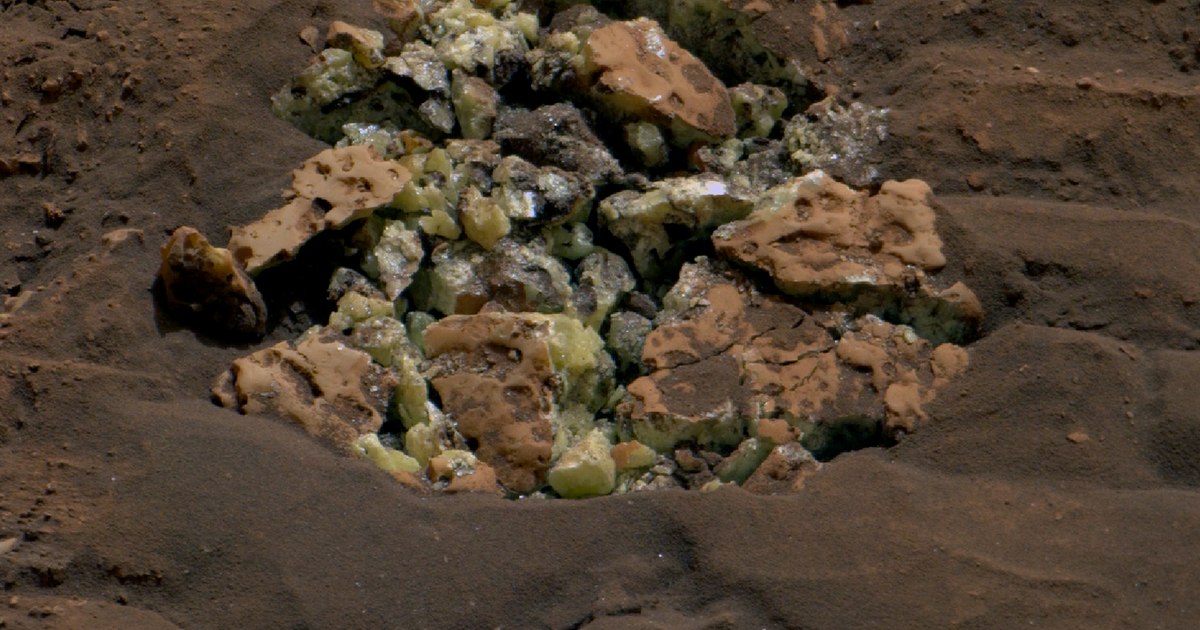
NASA’s Curiosity rover has made an amazing discovery on Mars. It all started when the one-ton rover ran over a rock, cracking it open and revealing yellow-green crystals never before seen on the Red Planet.
NASA’s Curiosity rover found pure sulfur crystals. PHOTO NASA/JPL-Caltech/MSSS
“I think it is the most unusual discovery of the whole mission and the most unexpected,” said Ashwin Vasavada, Curiosity’s principal project scientist at NASA’s Jet Propulsion Laboratory in Pasadena, California. “I have to admit, there was a lot of luck in the middle. Not all rocks hide interesting secrets inside”, according to CNN.
The Curiosity team was eager for the rover to explore the Gediz Vallis channel, a sinuous depression that appears to have been created 3 billion years ago by a mixture of flowing water and debris. The canal is carved into the 5 kilometer high Mount Sharp. The rover has been climbing this mountain since 2014.
White rocks had been spotted in the distance, and scientists on the mission wanted to see them up close. JPL’s rover drivers, who send instructions to Curiosity, performed a 90-degree turn to position the robotic explorer so that its cameras could capture a mosaic of the surrounding landscape.
On the morning of May 30, 2024, Vasavada and his team analyzed the Curiosity mosaic and noticed a crushed rock among the rover’s wheel tracks. A closer look at the rock confirmed the “amazing” find, he said. It is pure sulfur crystals.
Some of Curiosity’s discoveries, such as lakes that have existed for millions of years and the presence of organic materials, have contributed to the ultimate goal of the rover’s mission: trying to determine whether Mars ever hosted environments conducive to life.
Now, scientists are on a mission to decipher what the presence of pure sulfur on Mars means and what it says about the red planet’s history.
A spectacular discovery
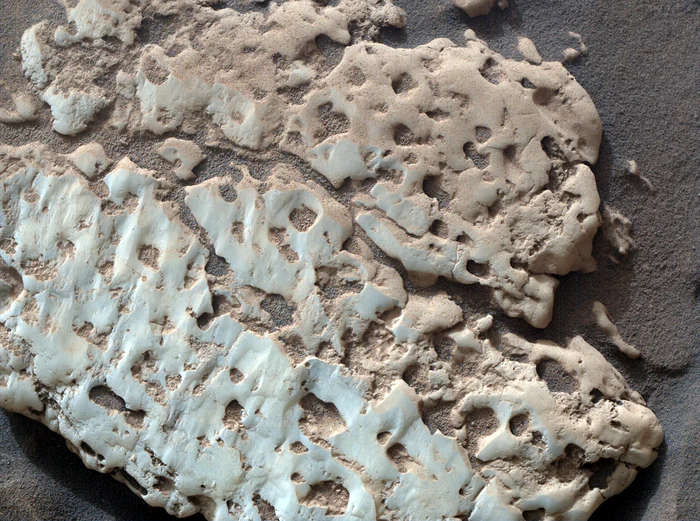
Curiosity had already discovered sulfates on Mars, or sulfur-containing salts that form when water evaporates. The team saw evidence of bright white calcium sulfate, also known as gypsum, in cracks on the Martian surface, which are basically hard water deposits left behind by ancient groundwater flows.
“No one had pure sulfur on their list of probabilities”, said Vasavada.
Sulfur rocks normally have what Vasavada describes as a “beautiful texture, translucent and crystalline,” but the weathering on Mars has basically eroded the outside of the rocks, so they blend in with the rest of the planet, which is made up mostly of shades of orange.
Earlier, while exploring Mars, NASA’s Spirit rover broke one of its wheels and had to use the other five to move back. Pulling the broken wheel revealed a brilliant white soil, which proved to be almost pure silica. The presence of silica suggests that Mars may have once had hot springs or steam vents, which could have created conditions favorable to microbial life, if it had ever existed on the planet.
The discovery of silica is yet another major achievement of the Spirit rover, which operated on Mars from 2004 to 2011.
