

The Ministry of Education and Research launched in public debate the new methodologies for filling the positions of school inspector. They provide for the prohibition of combining the function with a political one.
According to the project, management positions in school inspectorates become incompatible with holding positions of president or vice president in the leadership structures of political parties, at local, county or national level, with exercising the mandates of mayor, vice mayor, president or vice president of the county council or of the General Council of the Municipality of Bucharest, as well as holding leadership positions in trade union organizations.
Over the years, school inspectorates have frequently been accused of becoming tools to reward political patronage, while unions have in turn consolidated an important role in the system. “Adevărul” spoke with Zeno Daniel Șustac, president of the “Association for the Depoliticization of Education” (APDE), about the effects of this measure.
“We are not talking about real depoliticization, but about an appearance. A few months ago, APDE requested an institutional rethinking of the existing educational architecture by eliminating the ISJs as an intermediate administrative level, the transfer of administrative duties to educational units and local authorities, the establishment of an independent national evaluation and audit structure – separated from any political influence – as well as the radical simplification of decision-making flows and the reduction of bureaucracy in the system.
(..) Instead of a minimum openness to dialogue or a serious institutional analysis, the ministry transmitted, in a disarming wooden language, the exact legal framework for the operation of ISJs”he says.
Change of inspectors general after each rotation in government
The main sign of political involvement in the functioning of school inspectorates is the change of leadership and composition of these institutions after each round of elections at the national level.
“The most frequent approaches of this type – and implicitly, most of the guilt – come from the PSD-PNL-UDMR area: the change of general inspectors after each rotation in the government, the appointment of interim directors based on criteria of political proximity, the use of inspectorates as reward areas for political activists, etc.
As for the unions, there have always been suspicions that some of them are political puppets. They did not, in my understanding, fight for Education, they always pursued other goals, not necessarily “orthodox”. They stood out by blocking or postponing some reforms regarding the evaluation of teachers or the modification of the curriculum, the opposition to certain forms of differentiated pay, pressures to maintain some regulations on staff mobility and influencing ministerial decisions during electoral periods”says Zeno Daniel Șustac.
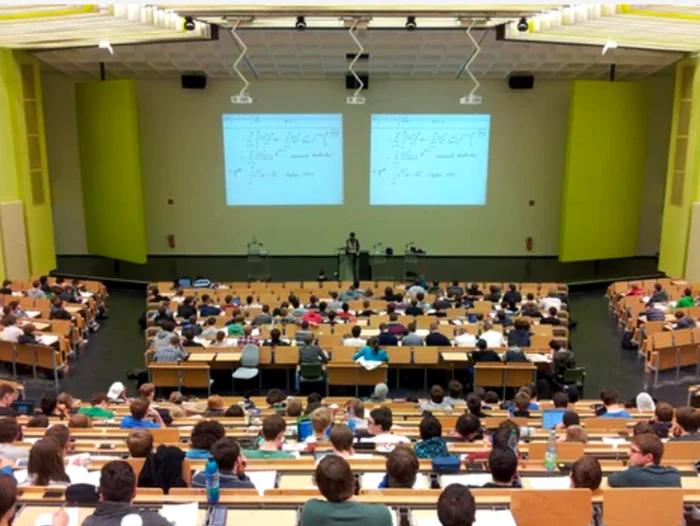
Even the students would no longer want rectors or deans anchored in politics
The National Alliance of Student Organizations in Romania (ANOSR) asks the Parliament to bring to the public debate a project that would prohibit the occupation of political positions by those in charge of universities. The reiteration of these wishes comes after the rector of the Polytechnic University of Iaşi, PSD senator Dan Caşcaval, was involved in a scandal after he announced to an internal group the enrollment of 220 students in the party. He later declared that he did not make political propaganda in the university.
An association asks the Minister of Education to abolish school inspectorates. “They don’t work as support structures for schools, teachers and students”
“Including in the debates held on the basis of the draft Law on higher education, in 2022, ANOSR drew attention to the need to introduce an incompatibility between the position of member of the Board of Directors of a university (Rector, Vice-Chancellors, Deans) and leadership positions in a political party, deputy or senator, member of the Government or Secretary of State”ANSOR sent in a press release.
Zeno Daniel Șustac believes that, in such cases, the resignation of the person accused of political propaganda is required, and the case from Iasi is not a singular one:
“The politician has captured almost all the universities in the country and turned them into extensions of the party. Regardless of the explanations given later, the simple association between the position of rector and the assumption of recruiting students into a political party seriously affects public trust in the institution of higher education. Education cannot be an extension of the party and cannot carry out political proselytizing activities! The university cannot be confused with the party, and the rector cannot simultaneously exercise the role of guarantor of autonomy university and that of a political actor involved in the expansion of a political formation.
Higher education institutions must remain spaces of academic freedom, not grounds for political recruitment. In order to protect the prestige of Romanian higher education and the principle of non-politicization of education, I considered that the resignation represents the only gesture of public responsibility”.
“The current model, generator of functional illiteracy, built on political control”
The new methodology will not be able to be applied too soon, as the establishment of the new organizational structures is, for now, extended until the beginning of the 2027-2028 school year. However, a positive aspect is that “the new profile of the inspector puts a serious emphasis on capitalizing on managerial and legislative skills”, says Şustac:
High school admission 2026. Brochures late, but registration for aptitude tests has begun
“It is well-known in Romanian society and in the international educational world that the current model, generating functional illiteracy, school dropout and country vulnerabilities, is built on generalized political control, not on competence, dedication and professionalism. In EU countries, competence in education, the educational partnership between society and the state and respect for teachers are valued. Dedicated and high-performing people in the educational system are put in the shadow of crooked hierarchies in which the leadership ISJs are earned by obedience and entrusted to “favorites”, not earned by performance and seriousness. The practice of undeservedly granting “power” to ISJs has been making the educational construction vulnerable for decades and must be urgently stopped; being a politician is not – in itself – a merit.
Most of those appointed (not at the head of ISJs) are politicians, party members with leadership positions in local branches, even local or county councilors. None has held a competition in recent years, at least, since the Ministry of Education refuses to organize it. These practices, perpetuated for over three decades at the ministerial level, are a shame on the face of national education and should be stopped urgently. We can no longer afford the professional CV in education to remain less relevant than the right party card. Neither in university nor in pre-university”.
