

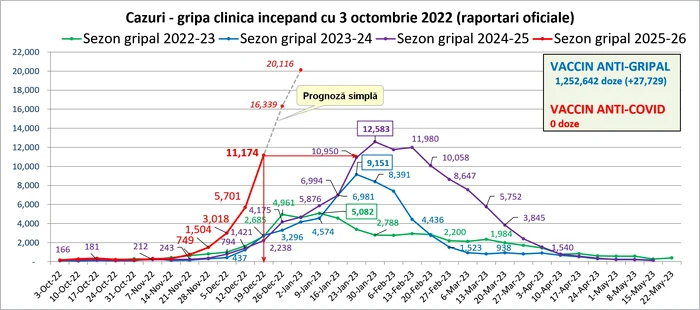
The number of new cases of flu has increased alarmingly in the last week, exceeding 10,000 new patients even during the winter holidays, experts warn, pointing out that things will get worse in 2026.
The data confirms the latest forecast that we will exceed 10,000 new cases per week right through the holidays.
“The value of 11,174 new cases registered last week already exceeds the highs of the 2022 and 2023 seasons and represents a 96% increase compared to the previous week, a new doubling of the number of flu cases in Romania from one week to the next. The average increase over the last 9 weeks of this flu season has reached 88% per week, a growth rate unprecedented in the history of the last 10 years of flu epidemics.
Even though this week’s growth rate has halved from last week’s, it’s almost a certainty that we’ll surpass 15,000 new cases, well above the all-time high of last year’s flu season, which was only recorded at the end of January. This means that, even with a drop in the growth rate to 25% in January, the peak of the current flu wave will pass the 20,000 new cases per week mark in January. Thursday’s report will confirm or deny this forecast (by simple extrapolation)“, stated the doctor Octavian Jurma.
The first death was also recorded
According to him, flu waves tend to go down slower than they go up, and we can expect in 2026 a January with constant values above 10,000 cases per week in the most optimistic scenario and constant values above 15,000 in the most pessimistic scenario.
“Unfortunately, the first death was also recorded, which marks the beginning of the increasing curve of deaths in the same period as in previous seasons.
It is far too early to predict how this curve will play out, as this year’s flu season has played out similarly to previous seasons through the end of November. We can still hope that the triple number of cases we are registering will not also translate into a proportional increase in the number of deaths, especially since the health authorities declared the epidemiological alert faster than in previous years, when it was declared after the peak of cases had passed, when it no longer made any preventive difference.â”, warns the doctor, pointing out that this somewhat more responsible attitude of the authorities has made the number of weekly vaccinations increase slightly to 27,000 vaccinations per week, an encouraging trend in contrast to previous years, when vaccination remained far below the normal values of approximately 3 million flu vaccinations annually, before the pandemic.
The strain has been circulating for over half a century
The report for last week confirms that also in Romania subclass K of the A(H3N2) influenza virus is dominant, so Romania is no exception this time to the rest of the world, despite the exceptionalism preached by the denialists.
“In order not to leave room for “virus invented by the EU” theories to fuel pro-Russian propaganda, it is important to emphasize that the A(H3N2) strain has been circulating since 1968, when the flu pandemic that started in Hong Kong caused approximately 4 million deaths globally in the period 1968-1970.
This historical reference is important to understand why waves of COVID-19 are still far more virulent than flu, even though the virulence of SARS-CoV-2 is declining, and also why we will continue to vaccinate against COVID-19 for many years to come, just as we do to protect against influenza, which continues to circulate despite whatever measures humanity has taken so far“, added the doctor.
In his opinion, if the annual occurrence of these flu and COVID waves is a certainty, then the need to decrease the impact of these waves on our health and the health of our loved ones is also a certainty. Vaccination must be part of our modern lifestyle precisely because our modern lifestyle helps the virus to adapt and spread faster than in the past.
“Returning to the ‘glorious’ past, when we didn’t vaccinate and half of our children died before they were 18 and life expectancy was under 50, won’t help; just as our lives will not be better if we give up brushing our teeth or giving up filtered water.
Although the hospitals are already full, as in previous years, the hard part comes only in January, upon returning from vacation, when the spread of the virus in the population becomes relatively homogeneous.
That is why I welcome the fact that the health authorities in Romania are coming to strengthen, through official recommendations, the unofficial ones that I supported with my colleagues, since the beginning of this unusually strong flu wave.
You can still get vaccinated for free or for a fee. You can protect yourself from infection through known non-pharmaceutical measures (mask in crowded spaces and hospitals, ventilation, distancing, etc.) and there are antivirals that can reduce the impact of your illness. Fortunately, influenza is a disease that is still addressed institutionally in Romania and we can use this advantage to avoid hospitals in the critical period ahead“, draws Octavian Jurma’s attention.
In Olt, all hospitalized patients are unvaccinated
And in Olt, the number of patients with respiratory diseases has increased considerably in recent days. Many of the cases are influenza, confirmed by clinical evaluation and/or rapid tests. Patients come with a high temperature, bad general condition, headaches and pains in the whole body, the most affected being very young children and the elderly, but also patients with chronic conditions, in which the complications can be serious. In the week of December 22-28, 2025, according to the data of the Olt Public Health Directorate, 114 cases of influenza were confirmed at the county level, clinically and through rapid tests, approximately half of the patients requiring hospitalization.
The head of the Infectious Diseases section of the Slatina County Emergency Hospital, doctor Oana Obretin, stated that many patients who were diagnosed with pneumonia, requiring hospitalization, showed up. There are people with pre-existing conditions, especially heart disease, who most likely had a flu and their health condition worsened.
“No vaccinated patient. They said they don’t vaccinate. For about 7-10 days, the cases have increased. They present with fever, headache, productive cough, slouching, myalgia (no – muscle pain), altralgia (no – joint pain)”the doctor stated, for “Adevărul”.
“Don’t stay at home anymore”
Children affected by the flu are treated in a special sector within the Pediatric ward, while the number of adults hospitalized with flu in the Infectious Diseases ward has exceeded 30, which means 60% of the total number of beds. The fear is that the number of those who need hospitalization will continue to increase, given the fact that we are going through a period in which people frequent crowded spaces, meet relatives, many arrived from abroad, and friends, spend time together, and people affected by the flu can be contagious even a day or two before symptoms appear. “For the time being, we have decompensations in the cardiac majors, in particular. (…) After Saint Ion, there will be a boom”, added Dr. Obretin. The condition of patients with chronic conditions also affected by the flu deteriorates rapidly.
“They decompensate from a cardiac point of view, they start having breathing difficulties, they need oxygen, they have very high blood pressure. I tell them to come to the Emergency Room, not to stay at home,” it’s the doctor’s call.
The elderly and very young children are also exposed to complications if they catch the flu, the doctor points out. Infectious disease doctors also consulted children as young as three or four months old, brought by their parents to the Emergency Room, which is why Dr. Oana Obretin draws attention to the need to comply with hygiene rules and avoid crowds, in order to reduce the risk of illness, especially since the period of maximum circulation of viruses has not ended.
“I see the peak in about two weeks. It will push the tide until February, even March,” aexclaims the doctor.
At the Emergency Department for the prescription of antiviral medicine
One of the reasons why patients, even those who could be treated at home following the instructions received by phone from the family doctor, for example, show up at the emergency room is that they cannot buy certain medicines from the pharmacy. This is the case of antivirals, which can only be released on the basis of a prescription that must be presented physically in the pharmacy.
Dr. Oana Obretin draws attention to the fact that treatment with antivirals can help a lot, shortening the period of illness and rapidly improving symptoms, but only if it is instituted in time, i.e. within the first 48 hours from the onset of the disease.
On the other hand, pharmacists confirm that they cannot dispense antivirals without the patient physically presenting the prescription (with a prescription sent on what s app the patient could also present at other pharmacies to buy the same medication) for such drugs. “You don’t give him that the patient woke up that he might have the flu. It’s not candy”draws the attention of Luiza Drăgoi, pharmacist, president of the Olt College of Pharmacists.
In order to prevent visits to the emergency room, if the situation is not very serious, it would not hurt, on the other hand, to have an “emergency kit” at home now, during the holidays.
In addition to the rapid flu test, which we can buy at the pharmacy, we should not miss: analgesics and anti-inflammatories, an antispasmodic for smooth muscles, anti-emetic and anti-diarrheal drugs, a probiotic – also helpful in case of diarrhea and in case of indigestion, rehydration salts (to restore the electrolyte balance in case of severe diarrhea or vomiting).
“I saw mothers walking their small children through the malls”
At the request of “Adevărul”, Cristiana Geormăneanu, primary physician in emergency medicine, from the Craiova County Emergency Clinical Hospital also spoke about the measures at hand to reduce the risk of illness.
“It is not too late to vaccinate ourselves. What we can do is to avoid crowds. Crowds must be avoided especially by people who are at the extremes, i.e. very young children and the elderly, because they are vulnerable. Patients with associated chronic diseases, especially those that debilitate: diabetes, cardiovascular diseases, oncology patients, patients with chronic kidney diseases, with diseases chronic liver problems. They have to avoid crowds, especially in closed spaces. I have seen mothers walking their children through malls, yes, but not in the mall, where there are a lot of people who come to shop. Some are coughing, others are in incubation period.draws Dr. Geormăneanu’s attention.
Healthy food is another ally. There is no “something to increase our immunity”, a miracle product, as the patients ask for, says Dr. Geormăneanu, instead there is a balanced diet: meat, dairy, cheese, fruit, vegetables, etc.. From the category of foods to avoid or to consume only occasionally are products with mayonnaise, ultra-processed products, fast food products, etc.
Wearing a mask, a gesture that four or five years ago saved us from many episodes of illness, we should bring it back into habits in the season of respiratory ailments, Dr. Cristiana Geormăneanu also points out. “It’s not a shame to wear a mask, it’s a shame to blow your nose and crack… on the asphalt. Cough, spit and throw up”the doctor also drew attention.
