
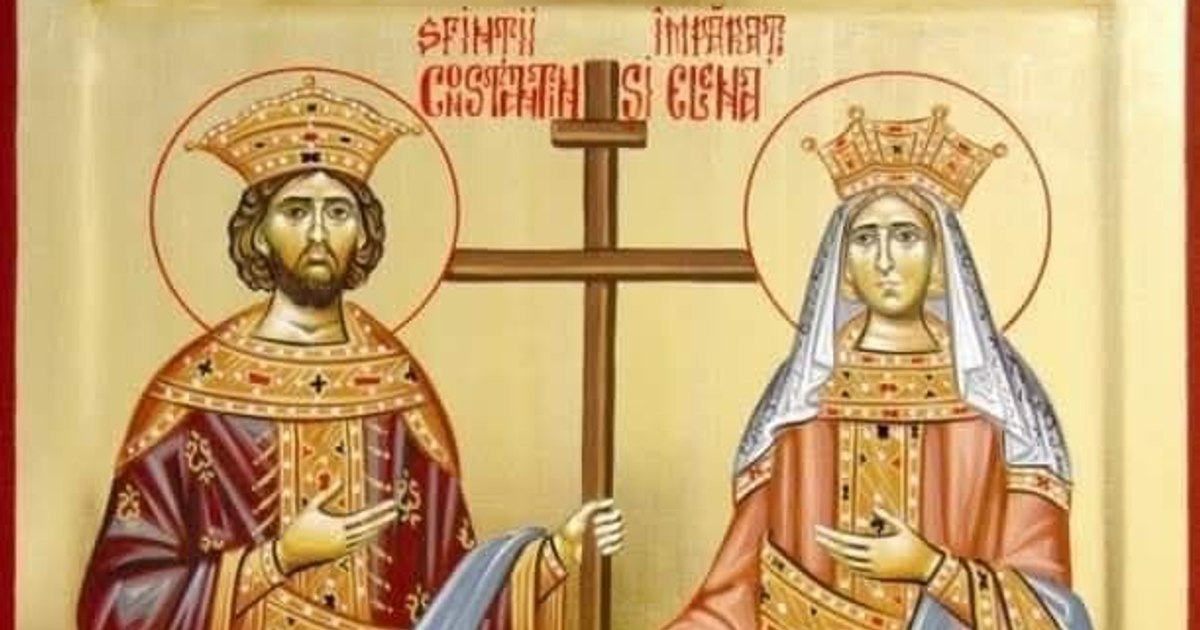
The Orthodox Church celebrates, year by year, on May 21, the Holy Emperors Constantine and Elena, those who gave freedom of Christianity and forbade the bloody sacrifices. Nearly 1.8 million Romanians celebrate their onomastics on this day marked in red in the calendar and to which many habits and superstitions are related.
Holy Emperors Constantine and Elena, iconographic representation. Photo Facebook Sorin Mazilescu
Constantine the Great was born in the city of Naissus (Nis, Serbia) around 274 and became sovereign of the whole Romanian Empire after the defeat of Maxentiu and Liciniu.
“According to the testimonies of Eusebiu and Lactantiu, on the eve of the fight with Maxentiu, Constantin saw in the sky, in a big noon, a light cross above the sun with the inscription: in Hoc Signo Vinces (through this sign you will overcome). It comes out victorious in the fight with Maxentiu ”explains the ethnographer Sorin Mazilescu.
On Constantin’s triumph arch, which is kept in Rome, the inscription is: “Instinctu Divinitatis ”, which translates “through divine inspiration”, indicating how Victoria was won on Maxentius.
“The most important achievement of Emperor Constantine was the edict in Milan (313), by which Christianity becomes recognized by the state. However, he will become a state religion during Theodosius the Great (379-395). After the edict of 313, the emperor exempts the tax of taxes, grants the right to receive the right to receive the right to receive the right to receive the right to receive the right to judged according to the laws of the state. Say Sorin Mazilescu.
Constantin the Great convened the first ecumenical synod in Niceea
Emperor Constantine is the one who convened the first Ecumenical Synod in Niceea (325), where after long debates, Arie’s teaching was condemned and adopted a formula that the Son of God is a being with the Father and therefore, with him.
“At the Synod were also made up the first 7 articles of the symbol of faith (the belief), it was fixed given to the steps (the first Sunday after the Full Moon, after the spring equinox) and 20 canons were given to the church discipline,” recalls the well -known ethnographer.
Saint Constantine the Great was baptized on the deathbed by Bishop Eusebius of Nicomidia. Shortly after he died (in 337) in Nicomidia and was buried in the Church of the Holy Apostles in Constantinople, founded by him.
Empress Elena built the Church of the Holy Sepulcher
The mother of Emperor Constantine, Empress Elena Flavia Iulia Helena, was born in the province of Bitinia.
“In the year 293, the Romanian general Constantiu Chlorus, at the urging of Emperor Diocletian, divorces Empress Elena. This is not remarried, but lives far from public attention, but close to her son. He managed to discover on Golgota hill the cross on which Christ was crucified.”recalls Sorin Mazilescu.
Following the excavations, three crosses would have been found. It is said that, in order to identify the cross on which Christ was crucified, they touched the three crosses by one dead, and he rose when he was touched by the Cross of the Lord.
On September 14, 326, Bishop Macarie I of Jerusalem took the cross and raised it in front of the crowd.
September 14 became the feast of the Ascension of the Holy Cross in the Christian calendar. Empress Elena built the church of the Holy Sepulcher, the Bethleem Church, the one in Nazareth and many other holy places.
“Emperor Constantine, knowing the power of Christ, the one who crucified on the cross, believed in Christ the true God and baptized with his mother, the worthy praise (337). Subject to the will of God, he built a great and glorious city, Moved his old Rome’s chair there, commanding that city to be called the new Rome, entrusting it to the defense of God and too much of the Virgin’s (the Lives of the Saints, IX, pp. 1034, 1043) ”shows Sorin Mazilescu.
The significance of the names Constantin and Elena. Who celebrates their onomastics
The name Constantin is of Latin origin and comes from Constans, Constantis (“Constant “,” firm “). The ancient name Helene is explained by some by the Greek helane term (“torch“, “Faclie”, but also “sacred fire “at the holidays called Heleneia, dedicated to the goddess Artemis), and by others through Hele (“The burning light of the sun”).
Nearly 1.8 million Romanians celebrate their onomastics on Wednesday, of which 1.1 million are women.
The most common male name is Constantin – 422.622, followed by Cosmin – 116,727, Costel – 74.184, Costică – 23.698, Costin – 22,235 and Costinel – 10,513.All, 830,439 women bear the name of Elena; Ileana – 94.115; Lenuţa – 60,048; Constanta – 39,350; Ilinca – 29.328; Constantina – 19,238, according to a statement of the General Directorate for the Evidence of Persons.
Habits and superstitions
Over time, this great Christian holiday has been linked a series of habits and superstitions.
It is said that, in order to avoid the damages brought to the birds of the sky, this day is not worked. In some regions of the country it is the last day when corn, oats and millet can be sown.
There is the belief that everything that resembles this day will dry. Also on May 21, the shepherds decide who will be the sticks, where they will place the sheep and who will guard them during the pasture. To drive away unclean spirits, the women incense and sprinkle with the household.
The shepherds turn on the living fire
The feast day is also important for the shepherds: they then choose their beet, set the place where they will stop the sheep during the summer. The shepherds choose on the day of Ispas the guards who have to guard their flocks when they are in the pasture.
The shepherds light up on May 21, called the living fire. Together with the sheep, shepherds are around this fire. In the people there is a conviction that this ritual, fulfilled from generation to generation, has a protective role against damage and diseases in the interval spent at the sheepfold.
The milk of milk is stolen
In order to defend themselves from the evil spirits that steal the milk increase, the villagers keep the custom “The scarecrow of the witches“.
Each shepherd measures, on this day, the quantity of milk obtained from his sheep, noting it on a notebook, on “The lifelong of the increase”. It is believed that by measuring the milk, the increase of the house does not waste, and the witches do not have the power to steal it.
Constantine of the chicks
The feast of the Holy Emperors Constantine and Elena corresponds to the popular calendar with the folk holiday called Constantine Puilor or Constantin Graur, a holiday that refers to the forest birds.
The traditions practiced on this day bring and health to the households that fulfill them. In popular calendars, this day was known as “Constantin Graur” or “Constantinu Puilor“, Because, from this first summer day, the birds from the peak are beginning to learn to fly, after they were unraveling in Vlasie (February 11), they have been damaged and built their nests at Dragobete (February 24).
In order for the good will to gather in the family, on the feast day, people bring to the house at least three threads. Also, for health, one of the family members is good to take three peony, lemon flowers, bread and sweets, prepared in the house.
