
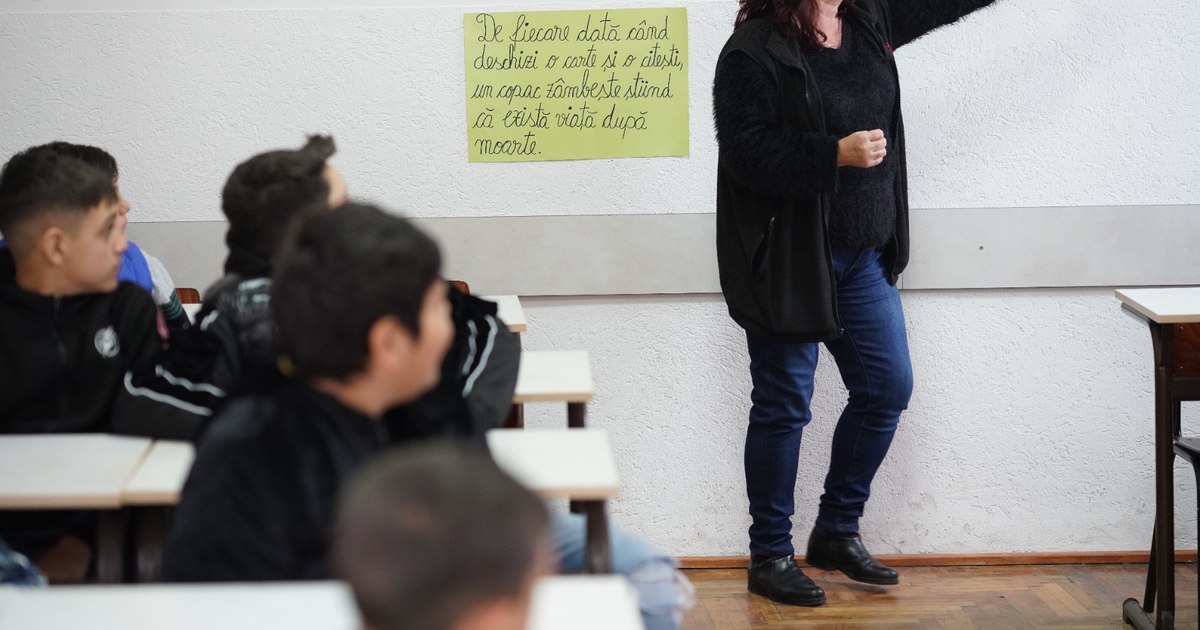
More than 16% of young people in Romania between the ages of 18 and 24 dropped out of school early, according to a European study. And the poverty rate was, according to the National Institute of Statistics, 19% in 2024. The figures are not independent, but grow together, year after year. But beyond the statistics, there is another, harder-to-measure reality: children growing up in vulnerable communities miss out on school not just because of a lack of money, but because school hasn’t shown them what they can become and hasn’t given them an environment where they have the courage to try. We spoke to several associations running dropout reduction programs to find out what really works.
“The relationship between teacher and student can make the difference”
The Trust School Association emphasizes the relationship between teachers and students, which it considers essential.
“We say about teachers that they are not only a guide for the child, but also for the entire community. Teachers are often the first adults who can notice that a child from a vulnerable background begins to withdraw, become absent or lose self-confidence. Or maybe there is an insecurity, a fear, a refuge. In many communities, the teacher is not only the one who teaches, but also the person who provides security, confidence and the feeling that “someone sees me”. Yes, again, for both the child and the parents. The relationship between teacher and student can make the difference between dropping out and staying in school.” emphasizes Letiția Suciu, executive director of the NGO.
To be able to make a difference, teachers need not only academic skills, but also know how to make students feel seen and heard at school. A chapter that in practice encounters numerous barriers. In universities, teaching staff are trained from a theoretical point of view, although in classes they are put daily in situations related to the psychology of relationships.
“We can do an exercise to think: why did we like a certain discipline more than another when we were students? More often than not, the teacher was the factor that made the difference between “I like school” and “I don’t want to go to school anymore.” Students need emotional safety to be able to develop cognitively”
says Letiția Suciu.
How to bring about change
The association has developed a program through which it aims to turn this desire into reality in as many schools as possible. And they provide support in such a way that teachers can develop their social-emotional skills and manage to find the right strategies to be with the students in their classes, especially if they are at risk of dropping out.
“We work with state schools from all over Romania to create environments where children feel safe mentally and emotionally, and teachers have real tools for connection, collaboration and well-being. We provide training, mentoring, coaching and support communities for teachers and principals. The feedback we receive most often is that teachers manage to change their relationship with students and parents, that the classroom atmosphere becomes safer and more collaborative, and children are more engaged and motivated to come to school.” explains Letitia Suciu.
When it comes to examples, the principals who managed to bring their colleagues closer to the chancellery come to mind, as well as a high school with a sports program that “after the implementation of the Trust School program, it had a 90% pass rate for the baccalaureate, the best in the institution’s history”.
The road is still long, but the association is moving forward with confidence.
“We will not deny that there were also teachers for whom the change proposed by us through the program was perceived as too difficult. However, we trust that those who want change for the better, start from themselves and build the good around them, in order to offer it to others. It’s a long, sometimes painful, emotionally difficult process, but it comes with a huge gift for the school community: well-being, healthy relationships and academic progress.”says Letiția Suciu.
Visits to employers and career guidance, other points that can make a difference
to Junior Achievement Romaniathere is another approach to reducing school dropout. It takes students out of classrooms and shows them what their future could be like through career guidance activities, mentoring, employer visits and virtual tours.
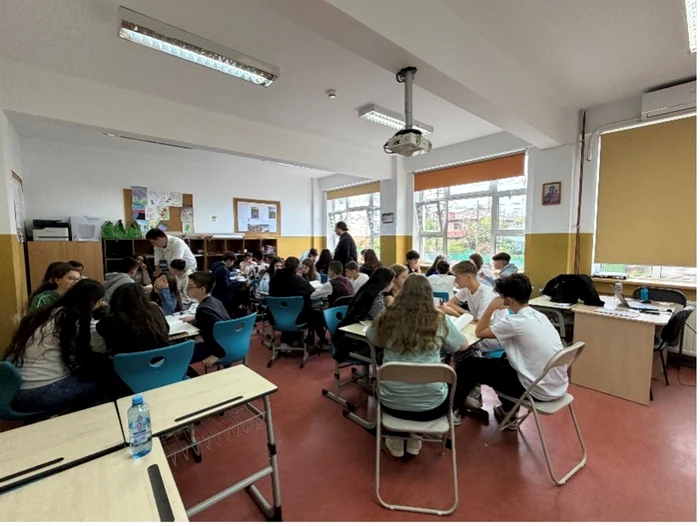
“We work in close partnership with the Ministry of Education, schools, teachers and volunteer consultants from the business environment. Annually, our applied learning and project-based programs reach over 300,000 pupils and students from over 1,900 educational institutions. All resources (kits, manuals, digital platforms) are provided free of charge”says Alice Cornea, CEO of the non-governmental organization.
The gap between needs and reality: we have more than a million vulnerable children, but less than 30,000 end up in day care centers
“Our goal is to show young people why they deserve to stay in school: education opens concrete doors to entrepreneurship (small businesses), financial independence, interesting professions and impact in the community. We use entrepreneurial volunteers who come into schools to narrate real experiences, which makes learning relevant.”
For teenagers at risk of dropping out of school, such stories can make a difference, highlights Alina Cernea:
“Many are used to a predominantly theoretical style, which demotivates them because they do not see the connection with real life. When we switch to “learning by doing”, we notice a noticeable change. (…) These activities help them build confidence and a sense of purpose, key elements in preventing school dropout and, implicitly, in continuing their studies”.
In the school in Moreni, Prahova county, they noticed even more what happens when students are encouraged to move towards practical applications. In one project, the students proposed transforming the school yard into an attractive environment that would encourage them to go outside instead of sitting on their phones. Among the ideas were: games painted on the asphalt, benches, educational QR-codes and the creation of a system of points and rewards, as part of a “treasure hunt”. The school is thinking about implementing the ideas.
When you stay in school, but it’s hard to reach your potential
Dropout is not a single-cause issue. And the consequences are felt at the level of society. And the result is a sad picture, with many affected lives and long-term consequences.
“In education, we see children who want to go to school, but the lack of access to resources, to teachers prepared to work with diversity, to an educational environment that accepts them as they are prevents them from having the path they want. Many grow up with no pointers to show them that education can open concrete paths to a different future. Where the context is missing, the motivation to stay in the system is also missing,” says Cătălina Murariu, executive director at the Dacia Foundation for Romania.
This brings up another topic: young people who don’t drop out of school but fail to reach their full potential.
“There are young people with real skills who fail to access the professional opportunities for which they have prepared – not for lack of ability, but for lack of access to the networks and mechanisms that transform potential into career paths. There are whole categories of people – with disabilities, survivors of domestic violence, young people from isolated communities – for whom the labor market remains a hard-to-reach space, not for lack of will, but for lack of opportunity,” Cătălina Murariu attracts attention.
What is the foundation doing to make things better?
“We finance programs that make education accessible and relevant for children from vulnerable backgrounds: non-formal education interventions, professional guidance, personal development, but also teacher training programs. We also support projects that show children, through direct experiences and meetings with professionals, that there are concrete paths beyond the context in which they were born”, answers the director.
Gifts for 1 June 2026 that get the kids out of the house: the best outdoor ideas on eMAG – from rollerblades and electric scooters to sports and adventures
Beyond the involvement of non-governmental associations, there is also a need for a joint effort by society and the replication of solutions that work.
“Romania has outstanding organizations that have built intervention models with proven impact in communities over the years. The problem is that these models often remain small, isolated, dependent on a single funder. A fairer society also means an environment in which a solution validated in a community in Vaslui can be replicated in a community in Cluj”emphasizes Cătălina Murariu.
Statistics that need to move the discussion forward
An OECD report published in 2025 shows that 16% of Romanian children between the ages of 6 and 14 do not go to school because they are not enrolled in the education system. By purchase, the European Union average is 2%.
The percentage doubles with increasing age:
“In Romania, 32% of young people between the ages of 15 and 19 are not enrolled in the education system, compared to 16% on average in OECD countries”the report states.
At the same time, Romania leads a not very honorable ranking in Europe. It is in first place in the number of young people between 18 and 24 years old who have graduated from secondary school at most. The percentage is 16.8%, almost double the European average of 9.4%.
