

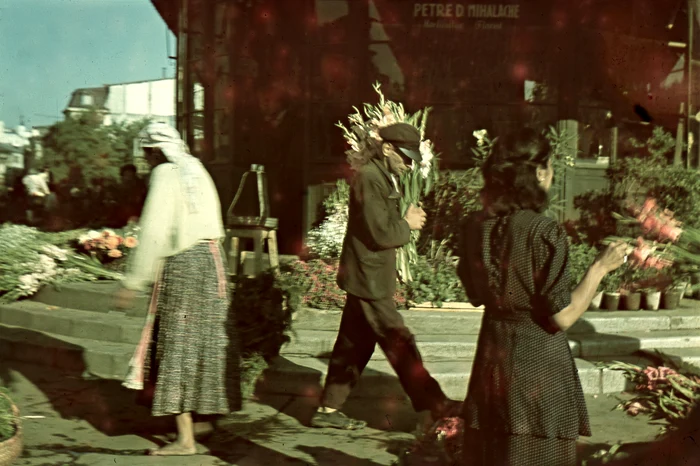
In the summer of 2025, on the fence of the Suțu Palace in Bucharest, the exhibition “Romania Agfacolor. 1940-1948” was presented, dedicated to the beginnings of color photography in Romania. The project, carried out by the Photography Archive, brought together over 250 early color images discovered in 2023, at the fair in Negreni, Cluj county. The photos come from the archive of Bucharest resident Gheorghe Neagu, a passionate amateur who captured, in the middle of the war, family scenes, landscapes and fragments of urban and rural life in the 1940s.
The research of this fund continues today, in an attempt to reconstruct both the route of the images and the technical context of the appearance of Agfacolor film in Romania. About this discovery, about the preservation process and about the significance of these photos “Weekend Adevărul” spoke with Radu Bârlă, researcher at the Photography Archive.
“Weekend Adevărul”: How did you get to the Agfacolor slide archive and what was the route of these images until they reached you?
Radu Bârla: We arrived simply and unexpectedly. I found them at the fair in Negreni, Cluj County, in June 2023. I found a box of slides for sale and were surprised to discover that they were early Agfacolor slides – and quite a few of them. That is, it is, in essence, the most extensive collection of early Agfacolor slides known from Romania, up to this moment. Obviously, a new one may appear. Their route to us is difficult to clarify. The idea is that they were part of a family archive, being images taken by a photographer from Bucharest – and part of the photographic collection of this family, the Neagu family, was at one point donated by one of the photographer’s children to the National Military Museum.
The aviator-photographer
I saw that the photographer’s name was Gheorghe Neagu…
I arrived at this name some time after publishing the first background images; and I arrived by chance, because the background does not contain details that lead to the establishment of an identity of the author or the people photographed. I arrived by chance, in the sense that this Gheorghe Neagu was recognized by two historians, who had previously researched two of the albums donated by his son to the National Military Museum.
As for the Neagu family, do we know more about how they got access to the camera equipment?
Gheorghe Neagu was not a professional soldier, he was a reserve soldier. He fought in both the First and Second World Wars, but was an amateur photographer, having studied Law. He was, in fact, an amateur cine-photographer, because in at least one frame we identified him with a video camera in his hand – so we know that he did film, probably on 9.5 cm format. What happened to his films is hard to say, because the photographic archive was also somewhat spread out – and these Agfacolor slides, to be sure, were more. But who knows if they were preserved, who took them, it is difficult to say at the moment how Gheorghe Neagu came into possession of the photographic equipment by buying it. He was a cinematographer who came from a wealthy family and could afford good equipment.
(Un)damaged images
What technical condition are the slides in?
It is not in a great state of preservation. Many of them are scratched. They have been mishandled over time, with some remaining in the slide frames they were originally mounted in in the 1940s, others having been remounted multiple times and obviously scratched. Agfacolor films are sensitive, especially the early ones, and react to storage in improper conditions – I mean temperature and humidity, especially temperature fluctuations – and as such have traces of storage damage. They were probably exposed to too much light at some point, there are traces that indicate this too.
There are some films in this collection that were definitely used after their expiration date, sometime in the early 1950s, between 1954-1955, they were produced in the 1940s. Probably, the photographer was left with a stock of one or two or three unused films and used them later. And these, from the start, were probably also poorly processed, due to the lack of technique and materials needed to process color film at the time. Obviously, within the project we have taken preventive conservation measures. Because all photographic documents, in essence, are self-destructing documents. This marriage of chemistry and paper – or other chemical media – is a failed marriage. No matter how many conservation measures we take, photographic documents will still disappear at some point.
Are there any pictures you haven’t been able to recover?
No, absolutely all the material was scanned, digitized. It is the first important step in photo preservation – to digitize and ensure that, no matter what subsequent damage occurs, the image is saved.
The digitized past
How long did the digitization process take?
Basically, the digitization and post-digitization of the image – because we are working from an archival perspective and want to preserve as much as possible, even if there are damages, the existing look of the image – probably took around 15 minutes for each frame.
Unique photograph of Mihai Eminescu, donated to a museum in Neamţ. It is in Veronica Micle’s house PHOTO
How does the digitization process actually proceed?
The film frames were carefully removed from their original frames, which were not subsequently reused, but were kept alongside each slide as found. Movies have been cleaned. After that, they were scanned with a professional scanner, at high resolution, and then the digitally obtained images were post-processed, trying to avoid interventions as much as possible, because, after all, from a documentary point of view, the condition in which the photographic document was kept is also important. The frames with specific damage – physical, chemical – were preserved. This process is: scanning, processing the digital image, inserting the film image into a new frame and storing it in the correct preservation conditions.
What do these images, from the 40s, tell us about daily life, about the people and places of Romania at that time?
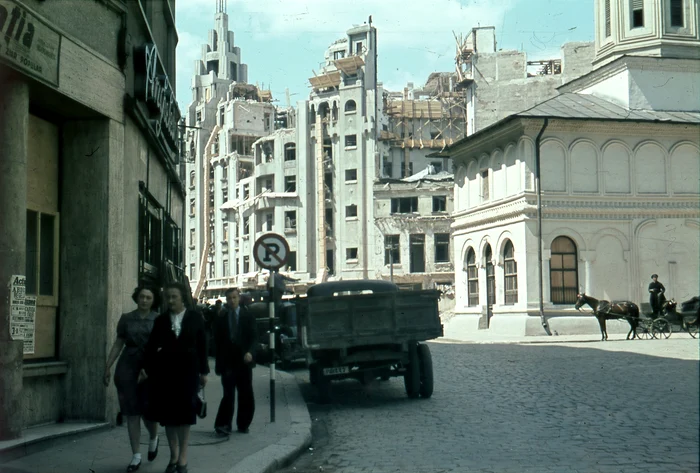
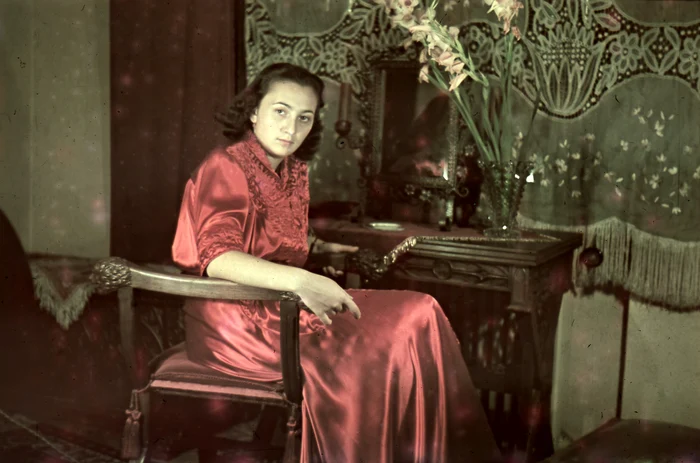
We must keep in mind that we are talking about a privileged social category for that period. The Neagu family had quite extensive estates in Teleorman. It is a well-placed family and tells us more from this point of view – about a family that lived mostly in Bucharest, with trips to the country estates, with walks and fun – than about the daily life of ordinary people of that period. We also see situations related to the realities of the war – bombed buildings in Bucharest, the aftermath of the 1944 bombings.
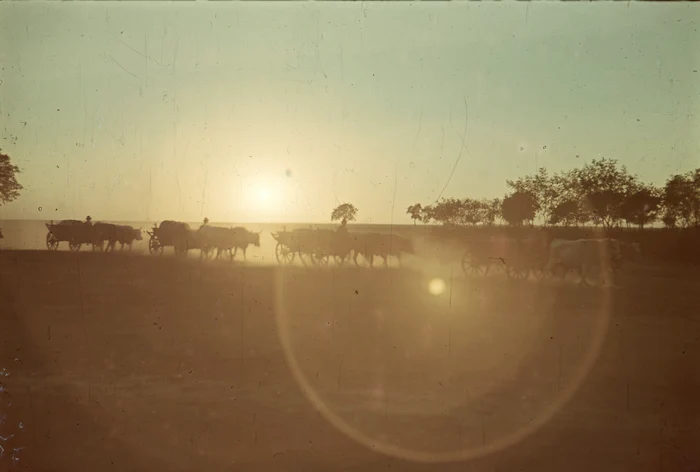
The images from around the country are essentially grouped around two trips, two trips made by the couple, on the occasion of the engagement and, after that, practically the honeymoon, as it were, after the wedding. There are shots from Brașov, from the Teleorman valley, around the family estate, and they are spectacular images: picking corn, carriage rides at sunset, returning from the fields. Instead, around the country there are somewhat standard images – they belong to the nature of the places the two visited. If they went to Brașov or Sibiu, they obviously visited the center.
We have frames in which, for sure, the images from the Gheorghe Neagu background are the oldest known color images for certain objectives, such as the Făgăraș Fortress. Otherwise, the images are more important for the history of Bucharest, because we see a series of areas and buildings that, in the meantime, have been demolished. For example, there is a frame that captures a corner of the Hall of Flowers, which existed in Piata Sfântul Anton, near Manuc’s Inn. We still have a series of frames taken from the Bordei Park area and from the current Primăverii neighborhood, including buildings that were demolished in the 70s. They are also interesting for social history because they are, for the most part, family photos from private events, parties, and even intimate portraits of the couple’s everyday life.
History is sold at the fair
What importance do fairs, like the one in Negreni, have in discovering the country’s documentary past?
They are very important and, unfortunately, they are treated in a bizarre way by the specialized public system, made up of museums, archives and libraries – on the one hand because of the way this system developed in Romania, and on the other hand for more objective reasons, such as deprofessionalization or legislative limitations in the field. We, being a private law organization, try to move a little more freely and logically in this world and make efforts to secure as much photographic heritage as possible, using these means considered by the majority to be unconventional, such as fairs and talcioks.
Including what we see in the specialist market, i.e. specialist websites or auction houses, are essentially archives that very often come from fairs – they are purchased by those who resell and then dismantled. Which is essentially a documentary tragedy, because a dismembered archive is an archive that loses its documentary value. And basically we end up with photo documents that are treated as a kind of Turbo gummy surprise. That is, collected by collectors based on theme, subject criteria. Someone collects cat objects, someone collects military uniforms, someone else objects or fashion.
And then, we find that from a family album, which contains 200 photos, of which only four or five have useful notations, we have nothing left, because everything is disassembled and sold piece by piece. It’s about the same thing that happens with the detectorist mania in archaeology. It is the pursuit of the object. But the specialist, at the moment the detectorist takes out a precious metal object, is blinded by the context. The archaeological context is lost. The same thing happens with photographic documents – the documentary context is lost.
How were you able to determine that the images were taken on Agfacolor film, not Kodachrome, for example?
For the simple reason that the films bore the manufacturer’s mark and the name of the photographic product. Photographic films, since their appearance, have been marked with the name of the manufacturer and, as the case may be, the type of film. The same goes for black and white movies, not just color ones.
Are there other smaller archives of photographs taken on Agfacolor films, in Romania or in Germany?
The first to mention would be the German photographer Hermann Lemme, who photographed in Transylvania, and beyond, in 1938. Then there is the aviation engineer Sorin Tulea. His frames still existed a few years ago, but they have disappeared. We also have the photographer Tadeu Cios, the owner of the workshop-laboratory “Photo Serviciu”. He also taught color photography to King Mihai I, in the 1940s. Finally, there is also the engineer N. Tomescu, who wrote in Romanian, for the first time, about the Agfacolor process.
