
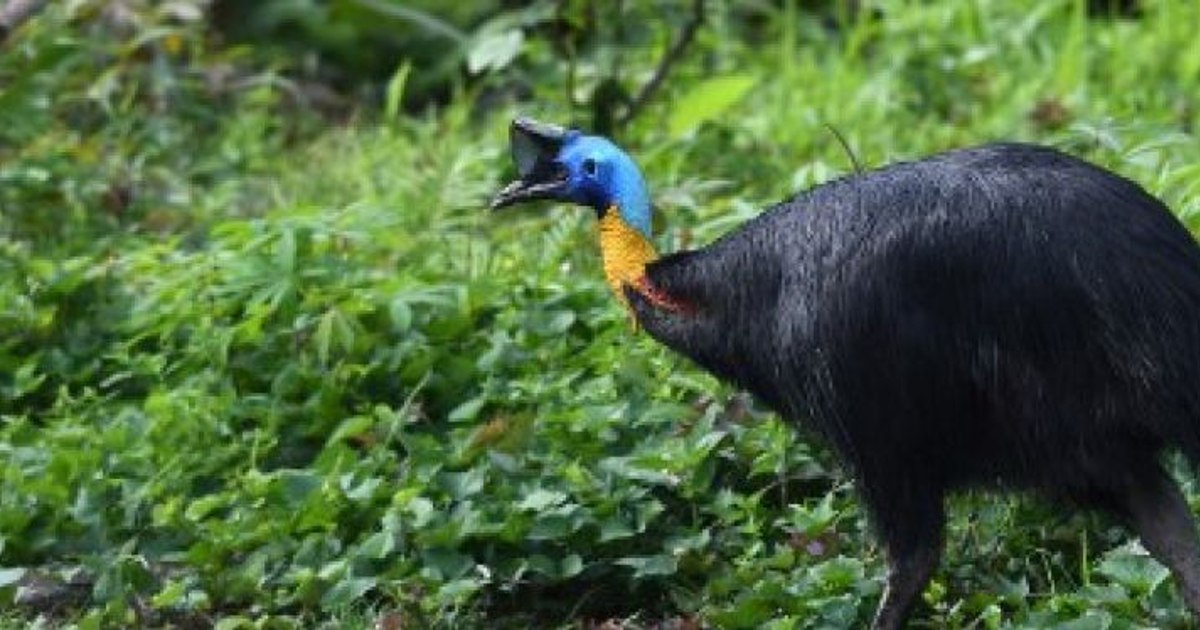
One of the most dangerous birds in the world due to its powerful talons and unpredictable behavior, it recently became the subject of a scientific study that revealed an unexpected feature: the horny outgrowth on its head can fluoresce under ultraviolet light.
The cassowary, a bird native to the rainforests of Australia and Papua New Guinea, known for its strength and the rare but severe accidents it is involved in, recently became the subject of a study published in the journal Scientific Reports.
The researchers discovered that the horny structure on its head, called a “casque”, can exhibit biofluorescence under ultraviolet light, with different patterns between species. The discovery adds an unexpected dimension to an animal already considered among the world’s most enigmatic birds.
A prehistoric rainforest bird
The cassowary lives in the dense jungle regions of northeastern Australia, Papua New Guinea, and parts of Indonesia. The best known species is the Southern Cassowary, a flightless bird but excellently adapted to running in dense vegetation.
According to scientific descriptions summarized in sources such as National Geographic, the adult can frequently exceed 1.5–1.8 meters in height and weigh over 70 kilograms, making it one of the largest birds in the world.
Why is it considered dangerous?
The cassowary has been described in the literature and conservation reports as one of the most dangerous birds to humans, not through constant aggression, but through the potential for injury.
Each foot has three toes, and the inner toe is equipped with a long claw, which can exceed 10 centimeters. In stressful situations or when feeling threatened, the bird can strike with considerable force, which has resulted in rare cases of serious accidents reported in Australia.
The discovery published in Scientific Reports
The study, published in 2026 in the journal Scientific Reports (Nature Portfolio), looked at the horny structure on its head, called a “helmet,” in several species of cassowary and found that it is not just a passive bony and keratinized formation, but exhibits active optical properties under ultraviolet light, according to Nature.
VIDEO “The most dangerous bird in the world” killed a man in the USA
The researchers exposed specimens to UV light in the 365–395 nm range and observed that the helmet material exhibits visible biofluorescence in the blue-green spectrum.
More importantly, the study shows that fluorescent patterns differ between species of the genus Casuarius, including Bennett’s Cassowary, Southern Cassowary and Plain-necked Cassowary.
What is biofluorescence and why does it matter?
Biofluorescence is a phenomenon by which certain biological structures absorb ultraviolet light and remit it in the visible spectrum.
In the case of the case, the researchers noticed that it was not just UV reflection, but a type of “optical signaling” which becomes visible only in certain lighting conditions.
The study points out that these signals may have functional potential, but there is no direct evidence that birds actively use them in communication.
Possible functions: communication, recognition or side effect
One hypothesis discussed in the paper is that fluorescent pattern differences could aid recognition between individuals, or even between species, in an environment where visibility is reduced by dense vegetation.
However, the authors of the study in Scientific Reports caution that it is not known whether birds can perceive these patterns naturally and whether they have a real behavioral role or are just a side effect of the horny structure on the bird’s head.
In the wider scientific literature, including popular syntheses such as those published by National Geographic, the helmet is already considered a multifunctional structure, possibly involved in thermoregulation, visual signaling or mechanical protection.
A “modern dinosaur” with still mysterious functions
The cassowary is often described as an evolutionary relic, due to its rugged appearance and solitary behavior. Related to emus and ostriches, the cassowary belongs to the category of birds that cannot fly, but has adapted perfectly to life in tropical forests.
In addition to the important ecological role of seed dispersal, the discovery of the UV properties of the “helmet” suggests that its structure may have functions not yet fully understood by science.
The discovery of biofluorescence in the cassowary adds a new piece to a complex biological puzzle. Between its ecological role, its reputation as a dangerous bird, and these optical signals invisible to the human eye, the cassowary remains one of the southern hemisphere’s most fascinating species, and recent research shows that it still has much to reveal.
