
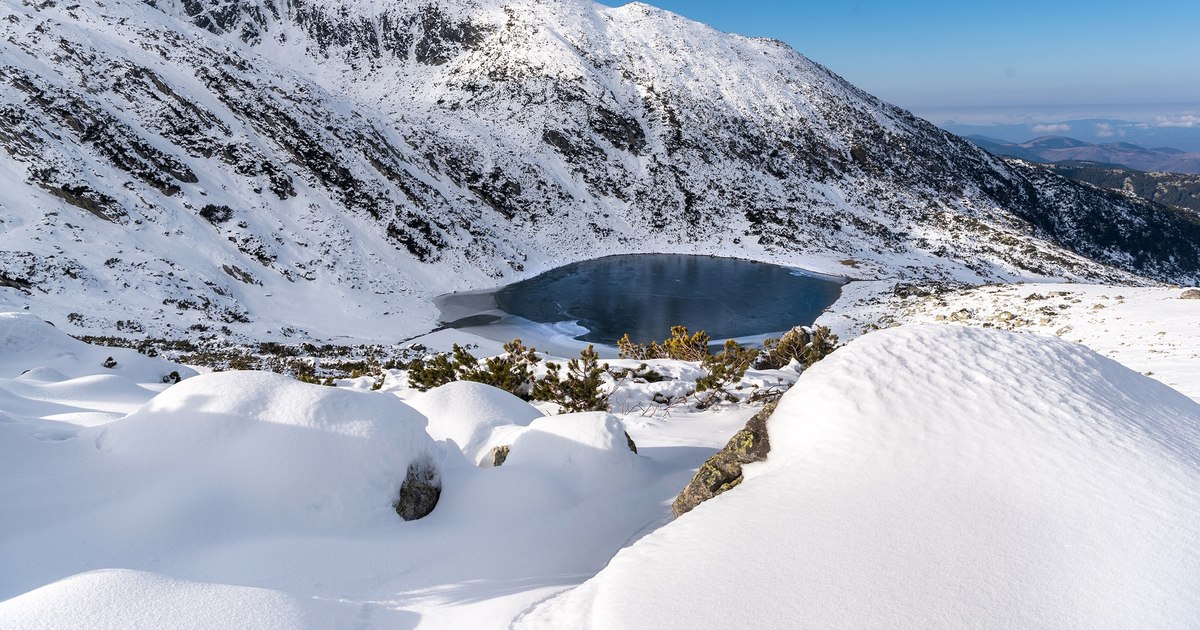
Located at almost 2,000 meters above sea level, in the heart of the Retezat mountains, the Galeș glacial lake is one of the few places in Romania where snow reigns throughout the winter. Covered by ice during this period, the lake offers its visitors unusual experiences.
Snow covers the highest ridges of the Retezat many weeks before winter makes its presence felt in other massifs in Romania. Peleaga and Păpușa, the highest peaks of the Retezat, exceed 2,500 meters, and around them almost 30 other peaks have heights of over 2,300 meters, most of which are covered with snow.
At their foot are the great glacial caldera, adorned by over 50 glacial lakes, many located at over 2,000 meters altitude. In winter, only a few glacial lakes remain accessible to tourists. Galeș Lake is among them.
Lake Galeș “seemed alive, under the ice”
Located at 1,990 meters above sea level, in the east of the Retezat, the glacial lake got its name from the archaic word “găleș”, which meant a deep, rounded place, like a bucket or a vessel, a term that describes its appearance.
Lake Galeș, formed by the torrent that descends from Zănoagele Galeșului, stretches over almost four hectares and is one of the deepest in Retezat, reaching almost 20 meters. The Galeșului stream springs from it, which connects it to Tăul dienre Brazi.
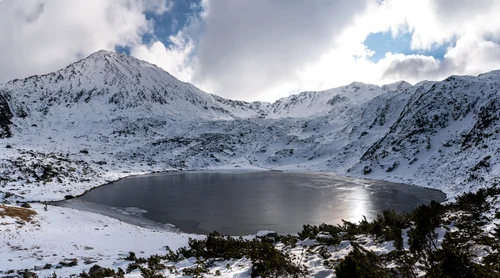
Daniel Morar, one of its recent visitors, arrived here by a difficult route due to its length, starting from Popasul Cârnic, an entry point to the Retezat National Park, and found it covered with ice and surrounded by snowy ridges.
“I took advantage of the thin layer of snow and, with the night in my head, I started towards Retezat, with Vârful Mare in mind, a peak that I only knew from summer tours. We knew that we had a long day ahead of us, with more than 20 kilometers to go, but the recent experience on Peleaga gave us confidence: the snow was only going to appear from the subalpine area, among the junipers, and it seemed small and well-placed enough not to create us difficulties on the steep climb to Saua Vârfului Mare (2,463 meters). It was the first time I saw Lake Galesu completely frozen, but above the image, I was impressed by its sound. Under the ice, the lake seemed alive, breathing deeply, with low vibrations, as I had never heard before – an experience hard to forget.” said Daniel Morar, on his Facebook page.
When returning to Cârnic, the hikers had to use flashlights, but the nocturnal atmosphere of Retezat delighted them.
“We were aware that the winter solstice brings the shortest day of the year, so the return to headlamps was almost certain, which was confirmed. Far from being an inconvenience, it was one of the joys of the tour: there is something special about walking at night through the forests of the Retezat, a stillness of moving shadows that makes you, from time to time, glance over your shoulder.” Daniel Morar reported.
The route Cârnic – Lake Galeș – Șaua Zănoagelor – Valea Rea – Cârnic can usually be completed in 8-10 hours, according to mountain rescuers. It has an average degree of difficulty and a difference in level of over 1,500 meters, and in winter it can only be walked up to Galeș Lake, according to the recommendations of the mountain rescuers. Tourists are advised to carry hiking gear, especially for this season.
“Starting from the Cârnic parking lot, the route follows the access road to Cabana Pietrele up to the point known as Curba Soacrei. From here, leave the blue lane marking that goes up to the cabin and cross Valea Stânișoarai on the blue triangle marking, for a section of several hundred meters, then cross Valea Pietrele, following the red triangle marking. The path climbs through the spruce forest, where, after about an hour’s walk, you can make a detour of about 20 minutes to admire Tăul di Brazi, crossing Valea Galeșului on the red dot marking. Returning to the main route, you reach the upper limit of the spruce forest, and after crossing an area with juniper, at an altitude of almost 2,000 m, you come across Lake Galeș”. informs the administration of the Retezat National Park.
The land of glacial lakes, to be seen in winter
Retezat, declared a national park since 1935, is one of the most admired places to visit in winter and, at high altitudes, along with the alpine areas of Parâng and Făgăraș, one of the few mountain regions where snow remains almost constant throughout the cold season.
Those who want to enjoy authentic winter landscapes have to make extra efforts and take some risks. Some ridges become inaccessible and are “forbidden” until the beginning of the following summer, and the forest roads in Retezat are difficult to traverse due to ice-covered sections, steep slopes and hazards created by unpredictable weather.
In Retezat, the glacial cirques are rocky basins with steep slopes, formed by the melting of glaciers, and together with the numerous lakes, stepped glacial valleys, moraines and grottoes represent indelible traces of the ice age.
“Nowhere in the Romanian Carpathians are the traces of this glaciation more grandiose than in Retezat. The wild, excavated relief of the mountain, with all the varied forms known so far by glacial morphology, is due to this era of terrible transformations”. noted the scientist Alexandru Borza, who led the process of establishing the Retezatu reserve.
The glacial lakes, the most admired “monuments” of the Retezat, were formed in the caldera of the glaciers, by the accumulation of water from rain and snow and by the discharge of the springs.
“In the caldera of origin of the glaciers, under the shelter of some morainic thresholds, are now seen charming lakes or sea-holes, the main attraction of the upper regions. Huge rounded and jagged rocks around dozens of green, blue, black, glittering, clear-eyed bulls are testimonies of the former crushing action of the glaciers”wrote professor Alexandru Borza, in 1937.
Difficult routes in winter, in Retezat
In winter, most of the glacial lakes in Retezat are difficult to access, and due to the risks associated with this season, some mountain trails to them remain closed. High winds, cold temperatures and thick snow can put even the most prepared hikers through their paces. The risk of avalanches should not be neglected, and the disappearance of markings under the snow significantly increases the danger of getting lost.
Fog, wind and snowy ridges reduce visibility, increasing the risks, and rocky areas covered with ice become the terrain of frequent accidents. The extended duration of the trails, the capricious weather and the wild relief of the Retezat are also worthy of consideration by those who go on the road.
Recommendations for winter hiking
Mountain rescuers recommend that hiking enthusiasts, before starting mountain expeditions during this period, check the weather forecast in the area where they are traveling and the ascent conditions. Also, tourists should pay more attention to the quality of equipment and clothing. It is important to stay hydrated and well-nourished, essential aspects for regulating body temperature, and to avoid risky actions.
“Never enter a closed area. Do not go out alone. Check weather reports, avalanche forecasts and local information. Use appropriate equipment and check its condition. Let a contact know what route you will take. Take the advice of an experienced person with good knowledge of the area you wish to travel. Do not go in a compact group, but behind each other, at a safe distance. Notify if be late. Ask professionals: mountain rescuers, mountain guides, ski instructors. Consider that there is no safe zone.” shows Salvamont Romania.
Communication and navigation systems (compass, phone with GPS applications, map), suitable clothing, water bottle, food, flashlight, a first aid kit, lighter or matches for fire and a blanket that can be used as an emergency shelter are essential in travelers’ luggage.
