
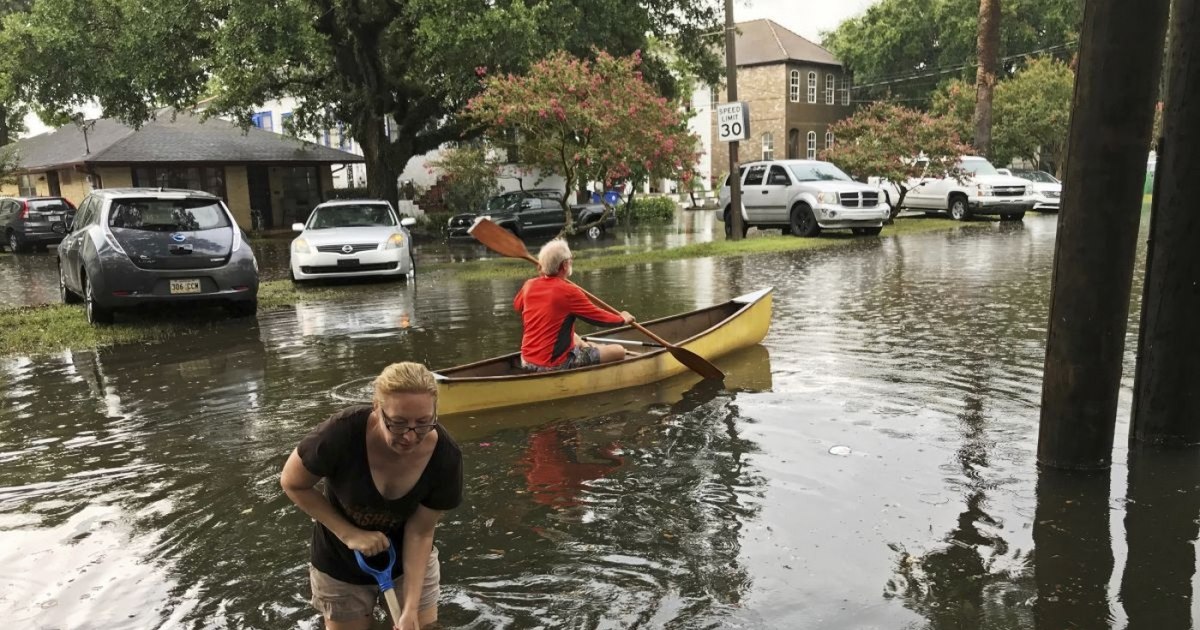
Researchers are calling for the urgent relocation of the population of a US city located in a bowl-shaped basin below sea level, the city already has 99% of the population exposed to a major risk of severe flooding, the worst exposure of any US city, according to a specialist study.
The process of relocating the residents of New Orleans should begin immediately, as the city has reached a “point of no return” and risks being surrounded by ocean in a few decades due to the climate crisis, according to the conclusions of a new study.
Continued sea level rise and accelerated erosion of southern Louisiana wetlands will engulf the New Orleans region within generations. The study published by The Guardian estimates that the city “could be surrounded by the Gulf of Mexico before the end of this century“.
Low-lying south Louisiana faces multiple threats, including sea level rise from global warming, increased hurricanes — a consequence of the climate crisis — and the gradual degradation of the coastline from the oil and gas industry.
The region faces 3–7 meters of sea level rise and the loss of three-quarters of its remaining coastal wetlands. This process will determine the shore “to migrate up to 100 km (62 miles) inland“, thus isolating the cities of New Orleans and Baton Rouge. The study compares the current situation with a similar period of global warming 125,000 years ago, when sea levels rose significantly.
Researchers believe that this scenario turns the region into “the most physically vulnerable coastal area in the world” and emphasizes the need for immediate action to facilitate an organized transition of the population of New Orleans, a city of approximately 360,000 inhabitants, to safer areas.
The dikes don’t help anymore
Louisiana has already experienced population decline in recent years, and this trend could accelerate wildly if steps are not taken to manage the major risks that threaten the city and surrounding communities.
“While mitigating climate change must remain a priority to prevent the worst consequences, coastal Louisiana has clearly already passed the point of no return.”says the study published in the journal Nature Sustainability. The article is of the “perspective” type, meaning that it provides an assessment based on existing data, not new results.
Billions of dollars have been invested in fortifying the city of New Orleans with a vast network of levees, gates and pumping stations, built after Hurricane Katrina in 2005. However, growing threats suggest that these infrastructures, already in need of major upgrades, will not be able to protect the city in the long term.
“Paleoclimatically, New Orleans is already gone; the question is when will this become apparent”said Jesse Keenan, a climate crisis adaptation expert at Tulane University and co-author of the study.
New Orleans is in a terminal state
Keenan estimates that the time frame for planning a retreat is on the order of decades, not centuries. “Even if we stopped climate change today, New Orleans’ days are numbered. It will be surrounded by open water and you can’t keep an area below sea level afloat. There are no financial resources that can change this”he added.
Hurricane Ida destroyed a historic building, considered the second home of the great jazz musician Louis Armstrong – PHOTO
Local, state and federal authorities should begin coordinating a relocation plan, starting with the most vulnerable communities, such as those in Plaquemines Parish, located outside the levee system.
“New Orleans is in a terminal state and that needs to be made clear”Keenan said. “But there is an opportunity to manage this transition – we can support people and the economy to adapt.”
He emphasized, at the same time, that political factors avoid discussing this reality publicly.
The city already faces major risks: Lying below sea level in a bowl-shaped basin, about 99 percent of the population is at risk of severe flooding — the highest among US cities, according to a recent study.
Wanyun Shao, a geographer at the University of Alabama and co-author of this study, cautions that there is no clear timeline, but the danger is imminent: “New Orleans stands out even compared to other American cities. It is experiencing one of the fastest sea-level rises in the world. It’s basically a ticking time bomb.”
She believes that relocation will become inevitable, despite the political and emotional difficulties: “Many people are deeply attached to this place, but controlled withdrawal will, at some point, be the only viable solution.”
Land is being lost quickly
A major factor exacerbating the situation is the rapid loss of land. Since the 1930s, Louisiana has lost about 2,000 square miles of land to coastal erosion—the size of the state of Delaware—and another 3,000 square miles could disappear in the coming decades. The pace is alarming: an area the size of a football field disappears every 100 minutes.
To combat this phenomenon, the authorities have proposed a plan aimed at natural restoration of the land by using the sediments brought by the Mississippi River. However, existing levees and infrastructure have blocked this natural process, directing sediment to the Gulf of Mexico.
The Mid-Barataria Sediment Diversion Project, launched in 2023, aimed to restore this balance and create over 20 square miles of new land over the next 50 years. However, the project was abandoned by Gov. Jeff Landry, who cited high costs and the impact on the fishing industry.
The decision has been criticized by experts, who warn that abandoning such initiatives accelerates the degradation of the region.
In parallel, legal efforts to force oil companies to pay for environmental damage are also in question after the US Supreme Court allowed an appeal of a decision by which Chevron had been forced to pay significant damages.
At least two dead and dozens of houses destroyed after a tornado hit the American state of Louisiana VIDEO
“The exodus has already begun”
According to the researchers, these developments indicate that the state is gradually giving up the fight to save coastal land, which is hastening the inevitable.
Although the United States has never completely relocated a large city, there are precedents for communities moved for economic or climatic reasons. In the case of Louisiana, experts suggest developing infrastructure in safer areas, such as those north of Lake Pontchartrain.
“The exodus has already begun”warns Keenan. “Without a clear plan, migration will become chaotic. The market will dictate the pace as insurance becomes unaffordable. Louisiana needs to face reality and act.”
Timothy Dixon, an expert on coastal environments, believes the problem is real, but stresses that the city’s demise is not imminent: “New Orleans isn’t going away in 10 years, but there should have been a resettlement plan a century ago.”
He warns that the necessary decisions will be difficult and unpopular, especially in the context of residents’ strong attachment to their city.
