
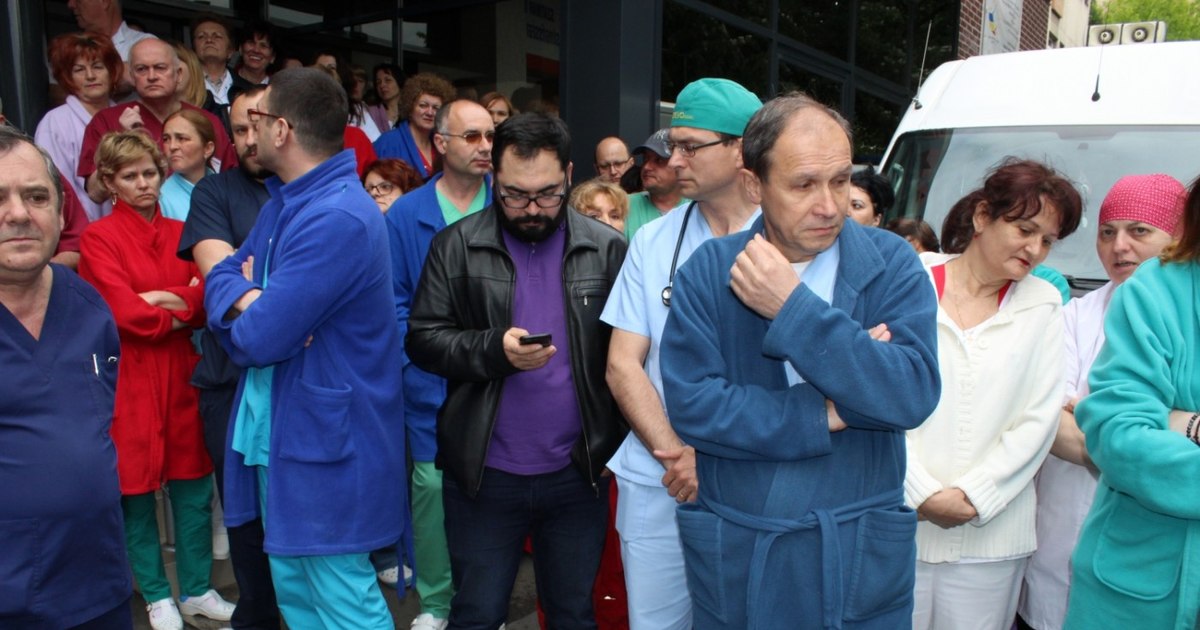
The SANITAS Federation has officially declared a labor conflict and announced the launch of a strike at the end of the month against the Government’s economic and social policies, which it considers unfair for health personnel. Trade unionists estimate the participation of 50,000 employees in the strike. Only critical services (UPU, intensive care) will be provided, and 66% of the activity will be interrupted. The demands of the trade unionists aim to restore salary rights, cancel the reduction in increments and resume the real dialogue, warning that the health system risks depopulation in five years if the salary law passes in the proposed form.
The trade unionists have scheduled a warning strike for July 20, followed by a general strike starting July 28, in all health facilities in the country. The decision comes after the discussions with the relevant ministries did not produce any concrete results, and the trade unionists accuse the lack of a real social dialogue and the blocking of communication with the authorities.
According to union leaders, services that put patients’ lives at risk will also be provided during the strike.
The vice president of SANITAS, Răzvan Gae, explained to “Adevărul” how the strike will take place and what patients should expect. He stressed that the unions expect to be challenged in court.
“The federation has officially announced the start of the labor conflict, so a warning strike is scheduled for the 22nd, and a general strike is scheduled for the 28th, and all entities involved, including the relevant ministries and the government, have already been informed. Yesterday and the day before yesterday, all employers in the collective labor agreement were also notified, to cover all legal aspects. We expect to be challenged in court, which is why we have to we are acting with great caution until the procedures are completed”it shows.
Regarding the continuity of medical services and the impact on patients, the union leader stated:
“In order to ensure the continuity of medical services, approximately 30% of the staff will remain at work to guarantee activities that put the lives of patients at risk, such as the ambulance, UPU, intensive care and operating rooms, and the health of patients will not be endangered in any way, but only non-urgent interventions, such as scheduled operations, will be delayed, so that, in principle, 66% of hospital activity will be interrupted, and 33% will continue to function, especially in the critical wards of nephrology, dialysis, gastroenterology and cardiology, which have intensive care units. Also, the warning strike will mean a maximum two-hour work stoppage, and if nothing is resolved between July 20 and 28, we will go on a full general strike.”
About 50,000 medical staff could go on strike
Gae said there is no exact figure yet on the number of doctors and workers who will go on strike, as the collection of signatures only started recently, but the unions estimate about 50,000 medical workers will participate.
Regarding the estimated number of participants in the strike, Răzvan Gae stated:
“We don’t have an exact statistic on the number of doctors who will go on strike, because the collection of signatures started on the 8th and we will make an assessment in the middle of next week, but we count on the participation of about 50,000 health workers, and those in social care will strike in solidarity, as it would have been very complicated to launch two strikes in different sectors at the same time.”
Doctors threaten to go on general strike. Sanitas confirms: “All the Government can do is respond to our requests”
The vice president of SANITAS sent a warning message about the long-term consequences of government policies on the health system, pointing out that if the wage law passes in its proposed form, the system will face accelerated depopulation, and the current level of staff is already at the limit of the minimum required.
Regarding the long-term impact of these policies on the health system, Răzvan Gae explained:
“Personally, I think this strike is an unfortunate exercise of what will happen in five years at the most, if the wage bill goes through as proposed, because the system will be depopulated more and more, and the current staffing level is already an alert one, at the limit of the minimum necessary.”
The lack of dialogue with the ministries, a source of frustration for trade unionists
The vice-president of SANITAS accused the lack of communication from the authorities, stressing that the unions have not received any concrete answer from the Ministry of Labor or the Ministry of Health, and the information appearing in the press is uncertain and not officially verified.
Regarding the discussions with the Executive, Răzvan Gae stated: “Regarding the discussions with the ministries, we have not received any concrete answer either from the Ministry of Labor or the Ministry of Health, but only unreliable information appearing in the press, such as the possible increase of the budget from 8.5 to 12 or 12.5, or that education would have received 1.5 million, but we have not been officially communicated anything, and at the Ministry of Labor, all communication has been blocked, so that no one can transmit or receive information without the minister’s authorization, and the employees were ordered not to talk to the press.”
SANITAS complains about the serious effects generated by several normative acts adopted recently, which have reduced the incomes and rights of health and social assistance personnel. Among them are the Emergency Ordinance no. 7/2026, which exempted from the reduction of personnel expenses only a part of the public health units, Emergency Ordinance no. 36/2025, which reduced increases for dangerous working conditions and additional vacation days, as well as Law no. 141/2025, which restricted the granting of food allowance and holiday vouchers depending on the level of the net salary. The trade unionists also challenge the draft Law on the remuneration of staff paid from public funds, considering that it is deeply unfair and was drafted in violation of the social dialogue procedure.
Doctors, close to a general strike. Pîslaru did not call them to negotiations even after they threatened that over 60% would leave the system
SANITAS Claims
The SANITAS Federation has formulated a series of requests addressed to the Government, including the restoration of the salary rights provided for in the Collective Labor Agreement, the cancellation of the reduction in increments and additional vacation days, non-discriminatory access to the food allowance and vacation vouchers, regardless of the ceiling introduced by Law no. 141/2025.
Regarding the salary bill, the unions demand the resumption of a real dialogue, the establishment of appropriate salary coefficients for health and social assistance staff, the maintenance of the shift increase at 15%, the maintenance of the 100% increase for work on weekends and public holidays, the reintroduction of the increase for working conditions, the inclusion of TESA staff in the same salary annex and the alignment of social assistance salaries at the level of the non-clinical health sector.
The trade unionists said that, in the absence of a concrete response from the authorities, the general strike will begin on the announced date, and patients are advised to reschedule their scheduled interventions for the period of the labor dispute.
