
The northernmost point of Romania, Botoșani county, is close to collapse. Paradoxically, the North Moldavian county is the second in Romania in terms of water availability, but the population and animals suffer from thirst every summer. Entire villages have no source of water and people have reached the end of their patience.
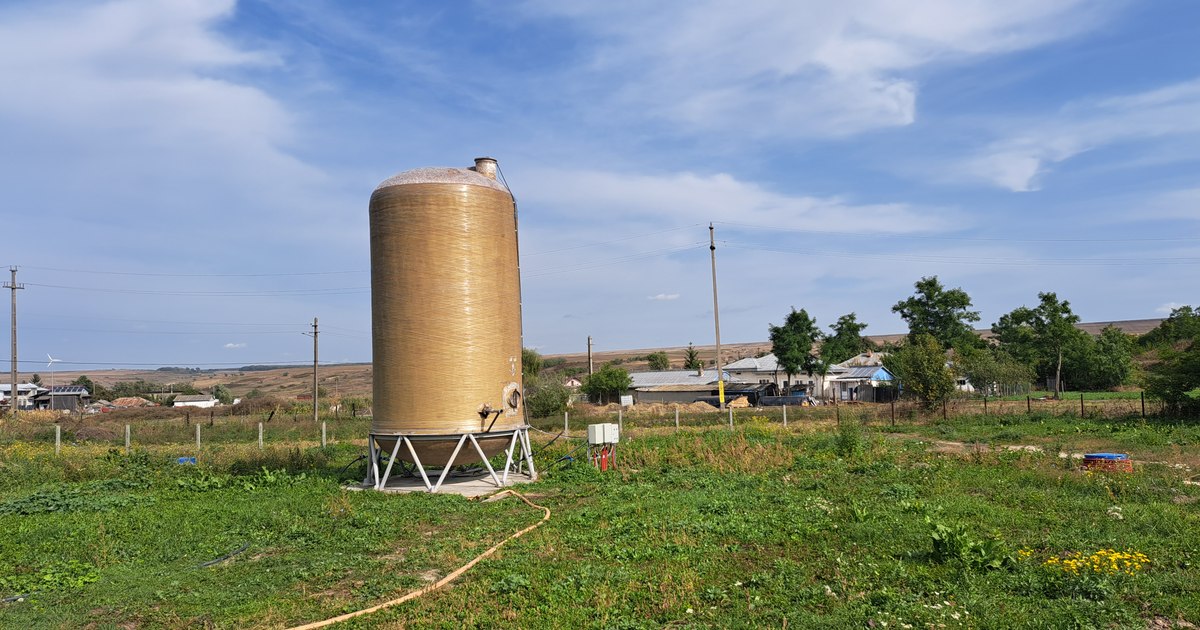
A reservoir, the only source of water for the locals of Cerchejeni PHOTO Cosmin Zamfirache
Botoșani County is in second place at the national level in terms of water surface area, with 3600 hectares. Botoșani has an impressive hydrographic network with over 148 ponds, large reservoirs and numerous rivers, the largest of which are the Prut and the Siret. Despite all this, paradoxically, in Botoșani, people and animals alike suffer from thirst. The water lies everywhere in the county, but it does not reach the taps of the population in any way. A catastrophic water distribution network, with half-century-old mains, a lack of investment, have brought the county to the brink of collapse, almost a calamity zone, for which the authorities are already demanding the establishment of a state of alert.
“The Realm of Thirst” from the “Kingdom of Waters”
The situation is extremely serious, as entire municipalities suffer from a lack of water. For example, Blânești, Ungureni, Flămânzi, Copălău, Drăgușeni, but also cities like Flămânziul. With the arrival of summer, the peak when people need water the most, many remain on dry land. Including in the municipality of Botoșani, the largest urban agglomeration of the city, there were frequent water interruptions but also low pressure. In other localities such as Unțeni, Răchiți, Stăuceni, Curești, there are water supply restrictions, that is, people receive water by the portion. In Cerchejeni or Frumusica there is no water at all. Besides, in the whole county, in every commune, there is at least one village without water, and in the others, water is given in portions, in hourly intervals, a few hours a day. According to official data, Botoșani is the most affected county in Romania due to the lack of water with 140 localities without water or with serious restrictions on water consumption. If in certain areas it is somehow understandable due to the limited hydrographic network, affected by drought, in Botoșani it is a paradox, as it can be found almost only in Romania. The county is full of water sources, but the water does not reach the people.
400 million euros lost
And the reason is the water distribution network, extremely old and damaged, but also the incompetence of those who should have rehabilitated it. In Botoșani county, the water supply is from Siret, Prut but also from reservoirs, through a network that is half a century old, designed during the years of communism for approximately a quarter of the current population of Botoșani.. The highways that actually bring water to communal or city networks are the main problem. They are old, undersized and broken. For example, the main line that carries water from Botoșani to Flămânzi, supplying all the communes over a distance of 40 kilometers, was designed with a flow required for only one spinning mill. Because of this, water almost never reaches Flămânzi. In addition, the main is so damaged that the representatives of the county water operator, Nova Apaserv, testify that they have losses of 80%. That is, only 20% of the water pumped into the pipes reaches the users.
Breakdowns are the order of the day in the municipality of Botoșani, but also everywhere in the county. In the town of Dobârceni, the locals are fed up with accidents. “There are always problems with water. Really always. The pipe is broken on one side, on the other. Mockery. And I think we still pay the losses. In two months I had water, twice, for half an hour, maximum one hour”says a local woman.
Nova Apaserv, a company with state capital, is in charge of managing the water situation in the county. More precisely, the shareholders are the County Council and also the association of communes in the county. The company has always had financial problems, there have always been accusations and suspicions that it is actually a politicized company where the performance leaves much to be desired. Moreover, the company would have lost 430 million euros, in two financial years, money from European financing, which Nova Apaserv could have attracted, through projects, and used for the rehabilitation of the mains, the modernization of the entire water distribution system , who obviously can’t cope anymore.
“We are at the end of our patience, we can’t resist like this anymore”
The people of Cerchejeni, a real Sahara in the north of Moldova, are at the end of their powers. They have had no water for years. They live on what the town hall brings them by tanker, in a 400 liter plastic water tank. And they and the animals. Water is brought from several kilometers away. In the village the wells are either dry or have no drinking water. “We are at the end of our patience. We can’t resist like this anymore. We live like disaster victims with water from the plastic can. They rush the people like hultans to take water in barrels, buckets whatever they can get. It’s hard to see, really hard“, says a local.
Many look for springs in villages or even neighboring communes. “We have no drinking water. We buy from the store. And next to us is the Dracșani pond, as big as a sea. We are dying of thirst too. Like fools. I walk around with a barrel wagon like crazy people. Maybe we can find a spring to get through today“, says another local from Cerchejeni.
In Dobârceni, the locals were happy that water supply pipes were laid in the commune. They rejoiced in vain. I get water with the portion. Sometimes not at all. There are locals who complain that the water has a strange color and are afraid to drink it. Furthermore, they are outraged that they paid, out of their poverty, a lot of money to make the adductions in the yard. “I put 2,200 lei into empty, dry pipes. It’s a joke. In addition, because the water keeps stopping, it spoils us here, it corrodes the pipes, it makes them miserable”, says a local woman from Cișmăneşti, Dobârceni commune. In Dobârceni, the town hall brings water by cistern so that the animals don’t die of thirst. “I bring ten shipments, that is, I brought 120 tons alone. We have no water in the town, we bring it from the Ichimeni pond“, confesses a villager from Drăgușeni.
Poor and thirsty
Botoșani is a rural county, where tens of thousands of people live exclusively from agriculture and animal husbandry. Personal discomfort caused by lack of water is the least of your worries. But they are worried that they will not have anything to eat. Without water I cannot water the vegetable gardens or water the animals. “We live from this. If they can no longer water the animals, if they no longer give milk, we are finished. Starving, beggars“, says a local woman from Copălău. In Drăgușeni, a commune where people live by raising cattle, the locals say that they are preparing to sell everything and leave wherever they can see.
“Without water we cannot water the cattle. There are people who are thinking of selling up and moving out. Disaster ensues“, says a farmer from Drăgușeni. Culmea, the water chiefs, still find people guilty, because they water their gardens from which they live. “The same problem remains: excessive, even excessive, water consumption considering the use of drinking water for agricultural work and gardens. I think it’s abnormal. Both the old networks and the new networks that will be processed in their design take into account certain technical aspects that are aimed exclusively at household consumption, and not the use of water for other things”, states Liviu Ștefan, director of Nova Apaserv.
Botoșaniu near the state of alert
Considering the desperate situation in Botoșani, prefect Sorin Cornilă is thinking of establishing a state of alert. “I am considering declaring a state of alert at the level of Botoșani county due to the problems the water operator has.”stated Sorin Cornilă.
