
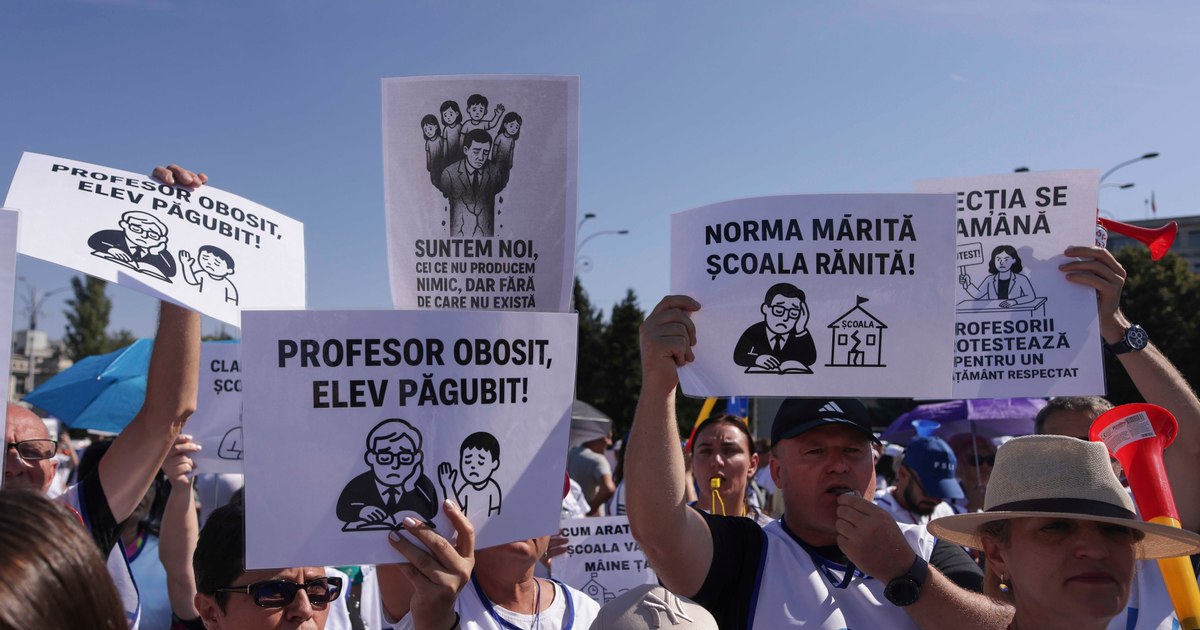
The version of the new salary law, which appeared in the public space on Friday morning and was rejected by the Ministry of Labor, which says that it “does not represent an official form”, blows up the government-union dialogue. Pre-university teachers accuse the political class of “burying education”.
“The documents that are circulating do not come from our institution and do not represent an official form”say the representatives of the Ministry of Labor, after, on Friday morning, a draft of the new unitary wage law was published.
The two federations in pre-university education have already announced a “intensification of protests”, if “The Government of Romania, the President of Romania and the political parties continue to ignore the reality of education”. Trade unionists reject several of the provisions of the new law and accuse that they were established without social dialogue.
“The Federation of Free Trade Unions in Education (FSLI) and the Federation of Trade Unions in Education “SPIRU HARET” note, with deep revolt, that the draft version of the new law on unitary wages (variant that appeared in the mass media and was not discussed with the unions) represents a flagrant violation of the legislation in force, a defiance of the commitments made towards trade union organizations and indisputable proof that the Government of Romania, the President of Romania and political parties bury education instead of treating it as the foundation on which the future of a nation is built”accuse the two trade union federations.
“The salary of a beginning teacher should have reached, in 2026, a level of approximately 8,600 gross lei”
The teachers’ complaints are related to the fact that everything that was previously discussed regarding the alignment of the salaries of pre-university teachers with those of other budget categories seems, according to the draft of the new law, thrown in the trash.
The project does not even remotely comply with the statements of the Minister of Education, Mihai Dimian, according to which “teachers must have motivating salaries that reflect the importance of their work.” On the contrary, “the draft ignores the provisions of GEO No. 57/2023, a normative act that unequivocally establishes the calculation basis for the salary in education, related to the average gross salary in the economy for the beginning teacher”the unions report.
The mentioned legal obligation was, moreover, never applied, and now it is practically abandoned, say trade unionists. “Under the conditions in which this provision would have been respected, the salary of a debutante teacher should have reached, in the year 2026, a level of approximately 8,600 gross lei, but in the project proposed by the Ministry of Labor, this threshold is not respected”, accuse the teachers.
Another dissatisfaction is related to “unacceptable flattening of wages”, the ratio between the salaries of those towards the end of their career and those of beginning teachers being abnormally low. “It is outrageous that, after those in power publicly claimed that the new salary law will be fair and that the anomalies in Law 152/2017 will be removed, the Bolojan Government proposes that the maximum salary of a pre-university teacher should not reach coefficient 3, on a scale from 1 to 8! Also, what was agreed in 2024 with the leadership of the Ministry of Labor and the representatives of the World Bank: the maximum salary of a pre-university teacher should be equal to that of a specialist doctor. Through this draft law, the difference is approximately 4,300 lei to the disadvantage of the pre-university teacher”. say the trade unionists.
The project also contradicts the principles explicitly assumed in the dialogue with the World Bank, “where the adequate remuneration of the teaching staff was recognized as an essential element for the functioning and reform of the educational system”accuse the teachers.
“The draft of the new unitary salary law is a deliberate political decision to keep teaching staff in poverty, with total disregard for the law, for their public commitments and for the future of this country. The Bolojan government is taking, through this project, a decision that ignores the long-term consequences and treats education with an irresponsibility that can no longer be justified. It is, in fact, an institutionalized contempt for education”also show the two signatory federations of a joint press release in which they contest the provisions of the new project.
“The silence of the President of Romania in the face of the destruction of public education is itself a political statement”
One of the teachers’ great annoyances is the lack of dialogue with the President of Romania, Nicușor Dan, whom they now accuse of “chose complicit silence in the face of an educational system in advanced collapse”.
Minimum salary, depending on seniority and education. How the incomes of Romanian employees could increase. The National Bank approved the proposal favorably
“Given that the education system is being destroyed by irresponsible political decisions, the President of Romania still has not found time for the teachers of this country. The silence of the President of Romania in the face of the destruction of public education is itself a political statement: that in the hierarchy of priorities of this state, children and teachers are not on the real agenda of power. At the same time, all the political parties that support, vote for and legitimize this government bear direct responsibility for every teacher who leaves the system, for every young person who refuses to enter a teaching career paid at subsistence level, for every child who is robbed of the right to a quality education.” the teachers also score.
The existing imbalances will be amplified if the law is adopted in its current form, and the costs of “irresponsibility” will be transferred to future generations, the teachers accuse.
“Qwe publicly ask Romania’s political class: Do you want an uneducated people? Do you want a country where capable people leave and those who remain are discouraged from investing in themselves? Do you see the direction in which education is being pushed outside the real priorities of the state?“, add the unions.
The two federations ask “full compliance with the provisions of GEO No. 57/2023 regarding the basis for calculating the salary of teaching staff”, but also “the urgent correction of the draft law on the unitary salary that appeared in the public space, in full accordance with the commitments made to trade unions and international financial institutions”, otherwise the protest actions will be amplified.
What the project provides
According to the substantiation note of the project contested by the unions:
– the level of increases is reduced in almost all budget branches;
– the possibility of granting the food allowance provided for by the current legislation is eliminated;
– the granting of an allowance for the doctorate degree is eliminated, this being taken into account when establishing the coefficients for the education staff, where, by the nature of the positions, it is necessary to hold a doctorate degree, etc.
For the Occupational Family of budgetary functions “Education”, the draft law provides for increases in the basic salary for all functions in the education system.
“The coefficients were established in accordance with the provisions of the Government’s emergency ordinance no. 57/2023, respectively the salary of the position of a beginning pre-university teacher is 23% of the allowance of the President of Romania”, it is shown in the statement of reasons, without making any further reference, for pre-university education, to the equivalence with the position of specialist doctor.
The equivalence appears, instead, between the position of professor in university education and the position of specialist doctor in clinical units.
Changes aimed at university education:
– The percentage of the basic salary increase granted from own income is reduced from 30% to 20%, “the difference being taken into account when determining the coefficients for the respective functions”;
What does the new single wage law promise? Dragoş Pîslaru: “To bring balance. Inequities are now greater than they were in 2017”
– The position of head university secretary has been repositioned in the new draft law so that the principle of the hierarchy of functions is respected, as well as the conclusions of the evaluation of the positions within the project;
– The variable part of the salary rights granted to this category of staff was elaborated taking into account the needs of the reform which requires the preservation of essential increments, thus ensuring equity in the public salary system;
– Merit grading and academic performance increase were replaced by the award for stimulating performance provided by the new law;
– The increase in neuropsychic overload was taken into account when determining the coefficients for educational functions;
– In the draft law, the auxiliary didactic functions from Framework Law no. 153/2017 were kept, and not those introduced by GEO no. 128/2024, because according to the law, auxiliary didactic functions can be introduced by joint order of the MEC and MMFTSS, and the common functions (such as those introduced by GEO no. 128/2024 as auxiliary didactic functions) can be found in the Administration annex. This principle is applied to all occupational families, say the authors of the project;
– For research staff, the draft law provides for increases in basic salaries considering the fact that this category of budgetary staff has not benefited, over time, from salary increases appropriate for the field of activity;
– The regulations specific to the clerical staff working in the country, within the religious cults in Romania, recognized according to the law, have been eliminated, because these regulations do not represent salary rights for budgetary staff and are not subject to the salary law.
