
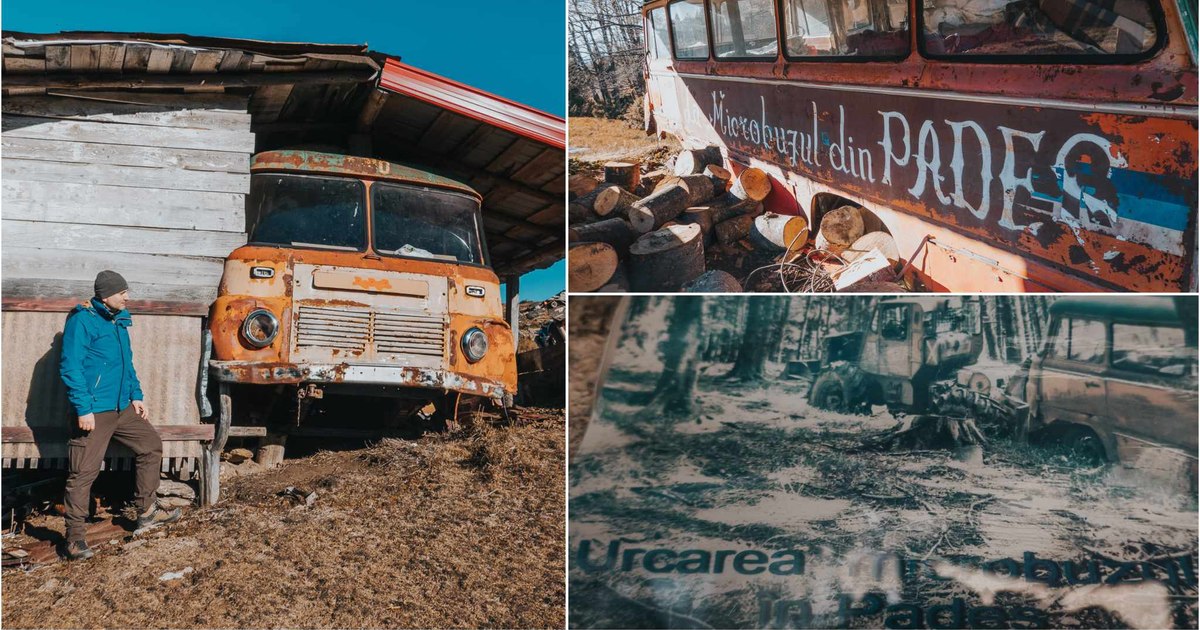
A vintage bus, transformed a few years ago into a mountain refuge, has become an attraction for tourists exploring the natural beauty around Padeș Peak, the highest peak in the Poiana Ruscă Mountains.
The bus shelter. Photo: Lucian Ignat
The Poiana Ruscă mountains have been known since ancient times for their centuries-old forests, iron mines and marble and stone quarries, and since the second part of the last century they have aroused the interest of the Romanian state for important reserves of useful minerals such as gold, silver, copper , lead, zinc, cobalt, uranium and chromium, some partially exploited.
Most of the localities around them, included in Hunedoara, Caraș-Severin and Timiș counties, have developed thanks to the forestry and mining industry, and the tourist potential of the mountainous region in western Romania has been less exploited.
However, the first tourist routes in the Poiana Ruscă Mountains were outlined since the beginning of the 20th century, as evidenced by the oldest monument dedicated to tourists, erected in Nădrag (Timiș county) in 1914.

Image 1/17:
Refuge from Vârful Padeș Photo Lucian Ignat (10) jpg
The stone monument bears the following inscription (in Hungarian): “If on your way you pass here, Enjoying these charming places, Throw the veil of forgetfulness over worries and thoughts, For only he who forgets can be happy”.
From the old mining town of Nădrag, travelers climb to the highest peak of the Poiana Ruscă Mountains – Vârful Padeș (1,382 meters), located on the border of Hunedoara, Caraș-Severin and Timiș counties, and can then descend to Ruschița (Caraș-Severin), Vadu Dobrii and Batrâna (Hunedoara), Luncanii de Jos (Timiș – video).
The bus perched on the mountain
Regardless of where they start, the trails to Vârful Padeș from the Poiana Ruscă Mountains (video) are difficult to cross in one day due to their length, at least ten kilometers on foot, but travelers who are caught on the road by nightfall can rest in one of the strangest mountain refuges in Romania, located in the vicinity of the ridge.
A decade ago, Nelu Balaș, a local from Nădrag who is passionate about hiking and knows the Poiana Ruscă Mountains well, brought a decommissioned Robur bus to the mountain, which he transformed into a shelter.
“I transported it with two trucks, made a terrace for it, and whoever reaches it can easily take shelter. There is a functional wood-burning stove, wood for lighting the fire, dishes for preparing food and beds for sleeping. My only request is that those passing by leave things as they find them when they arrive and do not steal. Refuge is everyone’s good”, recounted Nelu Balaş, in 2015, in the publication Redeșteptarea.
A decade after its inauguration, the bus shelter survived time and became a picturesque element in the scenery of the Poiana Ruscă mountains, show the images published by the photographer Lucian Ignat. Tourists also find here some “vintage” photos from when the bus was brought.
Nelu Balaș was the man who also rediscovered the old tourist monument in the Poiana Ruscă Mountains, hidden in the woods on the edge of the town of Nădrag.
A similar monument, erected in the 1930s from Ruschița marble (video), is located at the entrance to the commune of Rusca Montană (Caraș-Severin) and appears to be a stylized replica of the oldest tourist monument, on the other side of the mountains.
