
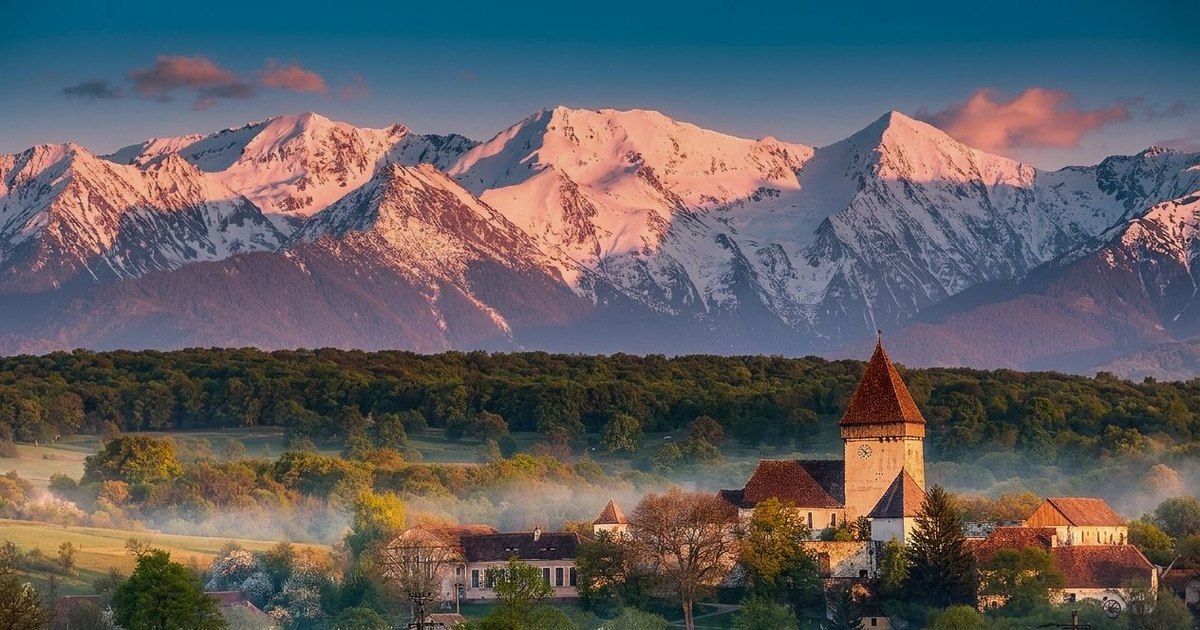
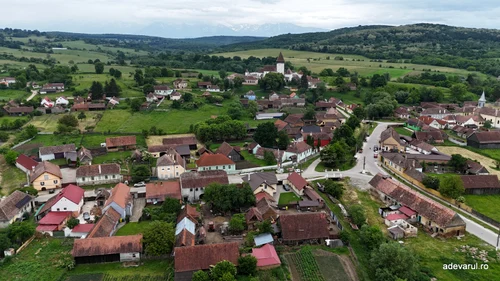
The Saxons return to Hosman, a picturesque village located 20 kilometers from Sibiu, in the Hârtibaciului Valley. The old Saxon town has become more and more animated by tourists, primarily because of its fortified church, watched from afar by the snowy peaks of the Făgăraș Mountains.
The fortified medieval church in the village of Hosman, built in the 13th century, was on the verge of being abandoned in the 1990s, when most of the local Saxons emigrated to Germany. However, the village community and the community in the West managed to save it from destruction.
In the last three decades, the church has been repaired several times and has gradually become an attraction for tourists traveling on the Hârtibaciului Valley, along the route connecting Sibiu to Sighisoara, passing through Agnita.
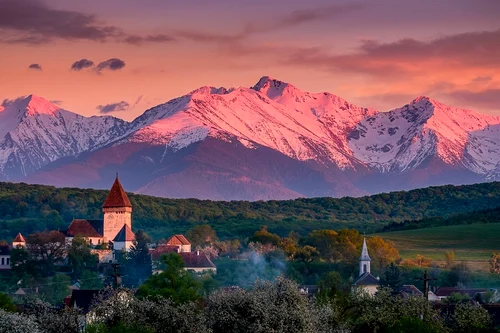
One of the reasons why the old evangelical church attracts the attention of tourists is its location. Raised on a hill and surrounded by two circular defensive walls, the church harmoniously integrates into the setting offered by the Făgăraș Mountains. From the bridge built over the Hârtibaciu river, at the entrance to the village, travelers can see the silhouette of the church, dominated on the horizon by the snowy ridges of Făgăraş for most of the year.
The picturesque village where the Saxons return in summer
At its foot, the old Saxon households line up in an orderly fashion: some are currently inhabited by Roma families, who moved here after the massive emigration of the early 90s, others by Romanians, and others by families returning from Germany.
“I emigrated from Hosman 35 years ago, around 1990. At that time, there were 400-500 Saxons in the village. Some managed to leave earlier, even to run away. Others, like us, had to wait until they had Ceaușescu as a carrot. Only then did we also receive approval to leave. Few returned, some old men, 80-90 years old now. Others, who they sold their houses and left Romania, they returned to the village after buying other houses. Then they also bought houses that were no longer inhabited.” Thomas Krauss, a local from Hosman, told for “Adevărul”.
For almost 30 years, before emigrating, Thomas was a driver for the Agricultural Production Cooperative (CAP), and after arriving in Germany he continued to work as a driver until a few years ago, when he retired. Now, he says, he lives in the Hosman house for three to four months a year during the summer.
“I was used to doing everything here, even if I only worked as a driver. In Germany, I was told: “You have no business with the car if it breaks down. You don’t do springs, engines, repairs. Others do that. You just drive”. It was much easier.”he recalls.
His wife, Katharina, worked for over two decades as a nurse in her home village. He then continued to practice the same trade in Germany.
“Here, at least, I had a hard time. Because I was the only nurse in the village. I didn’t have a night to sleep all night. Not at Christmas, not at Easter, not at New Year. Everyone came and knocked on the window. You had to manage here as best you could, because the doctor came once every two weeks.” Katharina remembers.
Since 1990, the landscape of the Saxon village in Sibiu County has undergone few changes, even if some of the Saxon houses have remained deserted. The medieval church continues to dominate the settlement, and religious services have resumed. The old mill was rehabilitated by the Hosman Durabil Association and turned into a tourist attraction that recalls local traditions.
Another non-governmental organization, the “Friends of the Mocăniței” Association, managed to save and put the mocănița from Hârtibaciului Valley back on its wheels, on a seven-kilometer segment. More than two decades after the closure of the Sibiu–Agnita–Sighișoara railway line, with the Cornățel–Vurpăr branch, only the portion between the villages of Hosman and Cornățel is used for tourist purposes from the route of more than 120 kilometers.
The fortified church, revived by locals and tourists
The mill, the fortified church and the mocănita attract more and more tourists to Hosman, says Silviu Nicut, representative of the European Center for the Meeting of Youth – Hosman Citadel Church (CEPIT), an organization involved in the preservation of the medieval fortified church and in the organization of activities for young people. In an interview for “Adevărul”, Silviu Nicuț spoke about the maintenance works of the church, the attractions of the village and the involvement of the Saxon community, but also about the growing number of people arriving in Hosman.
Romania, abandoned by most of the Saxons, Swabians and Jews. How the demographic structure has transformed in a century
The truth: How did your association get involved in the care of the fortified church at Hosman?
Silviu Nicuț, CEPIT representative: We are part, as an organization, of CEPIT, the European Center for the Meeting of Youth – Cetate Hosman Church. The parish house belongs to the Saxon community, as does the church. We have an agreement with this community and a contract by which we have rented the parish house until 2037. We want to promote the church and with the help of this association we are opening it for visitors. At the moment, in the summer, the church is open from Tuesday to Sunday, between 10 am and 5 pm. A volunteer found with the help of the German Democratic Forum is permanently present here. Monday, as with many historical monuments and museums, is closed. But it can also be visited on Monday. We have a phone number posted on the gate and we also have a volunteer from Germany who is here all the time.
What state is the church in? What are the most urgent jobs that need to be done?
The Saxon community was re-established. Every year people come and fix some urgent things. This year they rebuilt the access gate and started to remove the plaster from the walls of the fortress, because the water seeped in. Now they have started to refurbish that part. In order for the water to leave the walls, they will have to be left uncovered for three to four years, so that they dry completely.
The Saxon community, through Thomas Schneider and several other people who are Saxon and live in Germany, is actively involved. They come in the summer and every year they make time to do something here. We help them in organizing events.
What are the most spectacular elements of the fortified church, the ones you present to tourists for the first time?
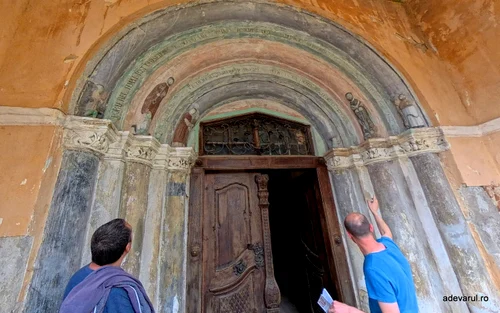
The most important element, the one that attracts the attention of tourists, is the Slăninii Tower. It was used in the Middle Ages to store food. Later, the village community also used it to store bacon, because it is very, very cold inside. The second important element is the western Romanesque portal, which has been preserved. Later, the church was converted into Gothic style, but that Romanesque portal is something unique.
I would also like to talk about the other tourist attractions in the area so that people can get an idea if Hosman village and its surroundings could be a day trip destination. Would people have anything to see here?
Hosman is one of the Transylvanian villages that have something special. In addition to the fortified church, we have the Moara Veche and the mocănita, which currently runs on a well-defined route, from Cornățel to Hosman and back. Now they have started reconditioning the line to Cașolț. The “Friends of Mocăniței” Association deals with this.
We collaborate with them. For example, next week we have a trip that I’m taking care of. We rent a coach, we bring the children, they go for a walk with the moped, and then we come here, visit the fortress and play some games.
For families who want to stay overnight, we can also offer accommodation here. We have very well maintained bunk beds and a kitchen where you can cook. The price is modest: 65 lei per night, per person. Also, if someone wants to stay with the tent, we can offer this possibility as well. It can be discussed. I think a visitor has something to do in Hosman, for sure.
Cisnădie, the Saxon fortress transformed into the textile city. How the ancient carpet tradition was lost
— You can also remember the panorama of the Făgăraș Mountains. The peaks can be seen behind, on the horizon, near the church.
The fortified church in Hosman is one of the most photographed churches, because behind it you can see the Făgăraș Mountains. It is extraordinarily beautiful and you can take a lot of interesting photos.
The Saxon community in the village is quite small. How difficult is it to maintain the church and carry out restoration projects? What should happen next?
From my point of view, its members are very active. There are a few people who get very involved. More recently, services began to take place at the church again. The organ in the church is functional. They rehabilitated the cultural home. Weddings and baptisms can be organized. So the community started to be active again. It is indeed very small, around 20 members, but services are also held. Somehow, things began to move.
We, as an association, CEPIT, have two very important events a year.
What are these?
The Holzstock Festival, which takes place in August, and the Christmas Market, held two weeks before Christmas. These are the most important events we organize. In addition to these, I am, strictly speaking, in charge of the children’s excursions. I prepare all kinds of activities that I want as fun as possible for them, so that they don’t lose interest very quickly. We also have, for example, in July, a support event for Moara Veche.
What kind of people get here? Are Saxons, Romanians, Germans coming?
It’s a mix of tourists. It is clear that a lot of Saxons are coming. During the summer, many people come. We don’t have a standardized record, but let’s say that somewhere between 20-30 tourists arrive here per day during the summer. They come individually, but organized groups also arrive. Then we can offer them a coffee or a tea.
