
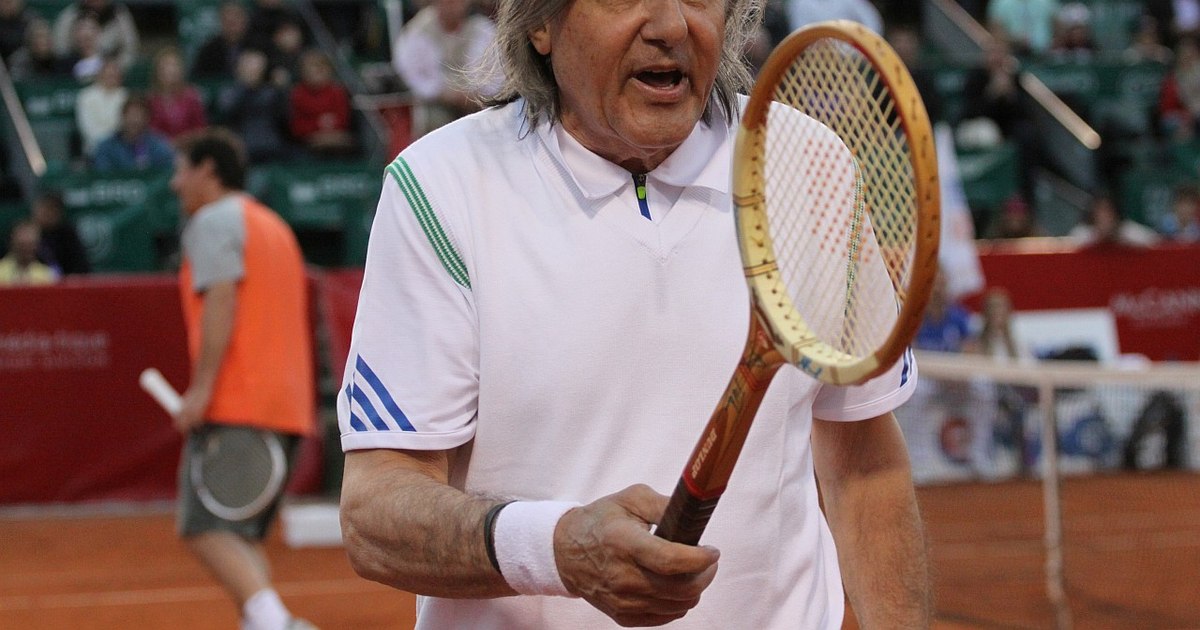
The tennis champion remains in the attention of the French media, which writes every year about the Romanian’s pranks. And “Nasty’s” good friend, Iranian Mansour Bahrami, praised him.
And at this year’s edition of the Roland Garros tournament, the journalists remembered Ilie Năstase. And they had no choice but to do so, this being one of the tennis players who wrote history on the Parisian clay. First of all, the Romanian excelled through his evolutions, winning the singles title in 1973 (6-3, 6-3, 6-0 with the Yugoslav Nikola Pilic in the final), as well as the doubles in 1970, alongside Ion Țiriac (6-2, 6-4, 6-3 in the final with Americans Arthur Ashe and Charles Pasarell). Then “Nasty” remained in the memory of everyone, including journalists, through his pranks. Not by chance, at the beginning of the 90s, the French daily “L’Equipe” considered him to be the player with the most humor in the history of Roland Garros.
And this year the sports daily from Hexagon, one of the most influential in the world, mentioned Năstase in its pages. More precisely, in a supplement of his, “Paroles d’Ex” (“Words of the former”), in which he collected memories of former great champions of world sport. And after reading the 40 pages you get the feeling that a dedication was made to the Romanian. Because many of the interviewees talked about him.
Bahrami: “Nasa had filled the arenas”
A good friend of the Romanian, Mansour Bahrami (70 years old) was the one who mentioned him the most. “Who’s the funniest player?” asked reporter Sophie Dorgan. And the 1989 Roland Garros doubles finalist said: “Yannick (Noah) had also been born. In Basel, Yannick came on court with a 20cm mustache on each side and he gave me a Rasta Afro wig. He’s got a clown face and a people-pleasing look. The referee didn’t know what to do, poor guy. In fact, after that match, he retired“.
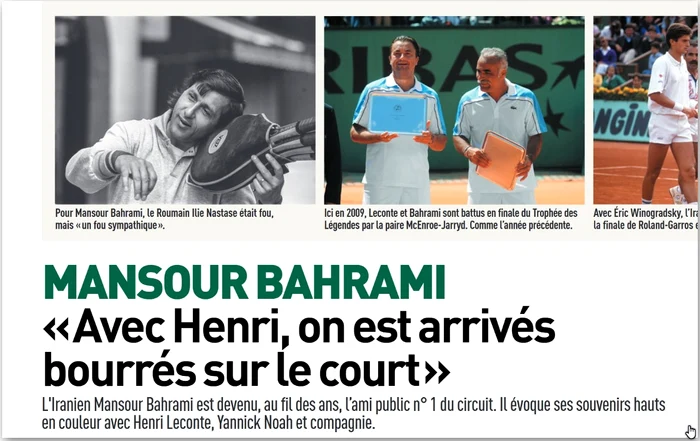
When it came time to say who was “the craziest”, Bahrami answered without any hesitation: “She had given birth. There is no one crazier. When he was world number 1, he was unbearable. People came to see him just to whistle him. I saw him pointing the finger at the referee, his opponent, everyone. But he was an artist. No one wanted to see Brad Gilbert, but Năstase filled arenas because he was a likable madman“. As for the “biggest partier” in the ATP circuit, here the Iranian mentioned several names: “Yannick, Năstase, Leconte. We were partying until 9 in the morning. Then we would take our things and head to the court to play the match. Henri and I, in Tokyo, arrived drunk on the court. The arena was full of 12,000 or 13,000 people”.
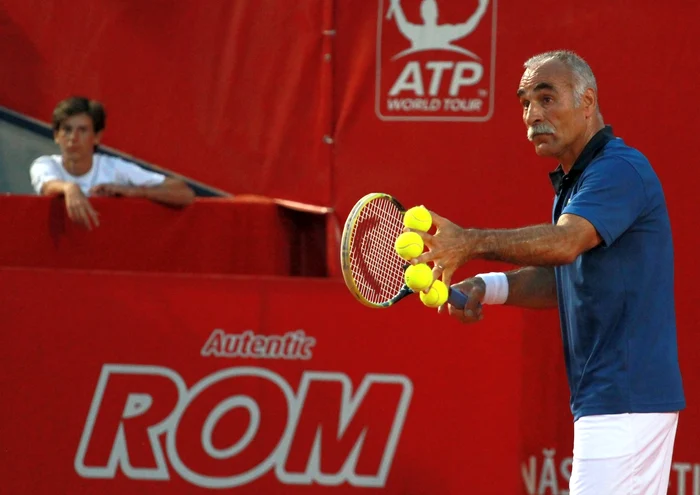
As the Islamic Revolution of 1978-1979 meant that tennis was also considered “a decadent Western activity” in Iran, Bahrami was forced to give up the sport for three years. He arrived in France, and there he met Năstase: “From my twenties to my thirties, I didn’t play on the professional circuit. I only played in France. I won the Marlboro Tournament and bought my own apartment. I was no longer homeless. When I arrived, I was sitting on the street. One evening, I saw Vilas and Năstase at Roland Garros. I had nothing to eat and I didn’t know where to sleep. Năstase told me: <
Jauffret: “He was mocking some of his opponents”
In the same supplement, Jean Francois Caujolle (73 years old) told journalist Charlotte Baillon that the funniest player he met was Ilie Năstase: “He was also the craziest. He was a comedian, a showman. I wanted to avoid him. I was afraid he would make fun of me. In his own way, he sometimes tried to mock his opponent because he didn’t like him. He was also an artist, a genius, an extraordinary guy. If he had been less crazy, he would surely have won more Grand Slams. He was a legendary player“.
A very good opinion about the Romanian champion was also issued by François Jauffret (84 years old). Asked by Bruno Garay about his toughest opponents, the former world number 20 replied: “I played against all the great players of my era: Jimmy Connors, Arthur Ashe, Stan Smith, Ilie Nastase, Manuel Orantes. It’s hard for me to say which one was the strongest. They had different styles. Smith was focused on discipline. Ashe had class, Năstase, creativity. But none of them have categorically dominated like Nadal, Federer or DjokovicThen the Frenchman said that he had played eleven times against Ilie Năstase, losing eight times in tournaments, but winning each time in the Davis Cup.
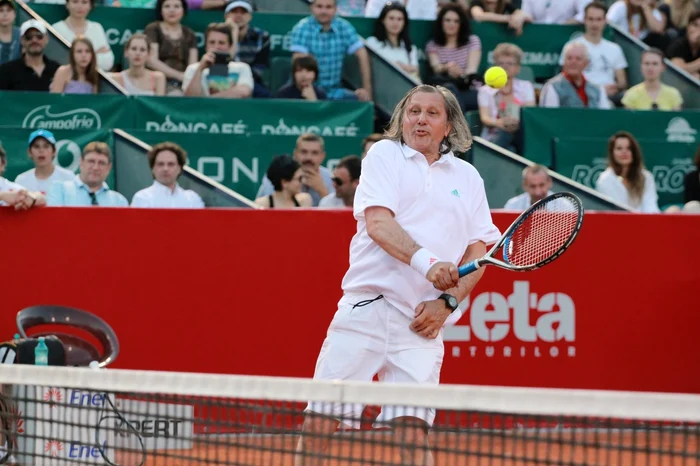
The day Ilie Năstase gave a lesson to Ion Țiriac. He returned the coin after the billionaire pulled the strings: “What did I do to him. He’s stuck!”
A similar opinion was expressed by the Argentinean Jose Luis Clerc (67 years old), world number 4 in 1981: “The craziest player I’ve ever faced? It’s simple: Ilie Năstase! My great friend, the one with whom I played many doubles matches. With Elijah, there are so many stories. Some we can say, others still not, even after so many years! I love this guy. It was a phenomenon. He taught me so much, especially here at Roland-Garros. People were begging us to double play. One year (in 1981), I had just won in Rome and here I was, in the semi-finals in singles, but also in doubles with Ilie! Back then, there wasn’t much space behind the pitches, and he sometimes went to pick up balls that landed in the third row of spectators at the Philippe-Chatrier arena. People were delirious!“.
Throw the rockets in the toilet!
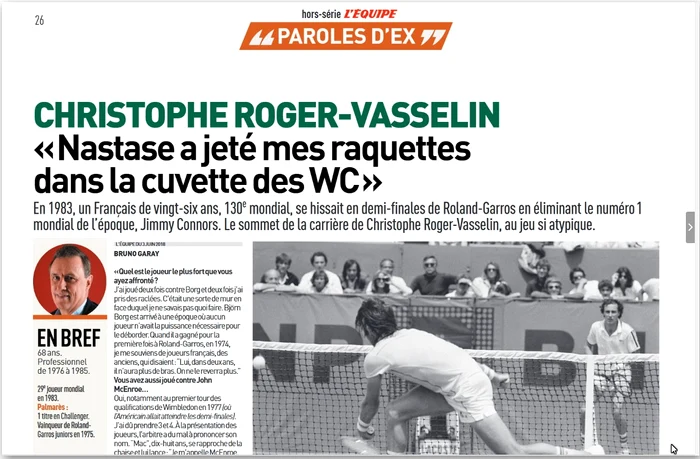
This year’s edition of Roland Garros was full of surprises. And the biggest was provided by Polish Maja Chwalinska. Ranked 114th before the start of the Paris tournament, she made it through the qualifiers and played in the final against Mirra Andreeva (19, seeded No. 8). A final clearly lost: 3-6, 2-6. It was not, however, the first time that someone with such a poor ranking reached the final stages there. In 1983, for example, Christophe Roger-Vasselin (26 years old, 130th ATP) managed to reach the semifinals at Roland Garros after defeating the then world number 1, Jimmy Connors. The Frenchman told the journalist Bruno Garay from the daily “L’Equipe” about that match, but also about the confrontations with other stars of those times, such as Björn Borg or John McEnroe.
Asked who was the tennis player who disappointed him the most, Roger-Vasselin replied: “I’ll just say that Ilie Năstase threw me a rather unfunny party. In 1981, I played against him in Cincinnati. Sensing he was going to lose, he made the audience laugh at me. He parodied my lapel, which was less orthodox. After I won the match, I went back to the locker room, put my rackets in the locker and went to the hotel. When I returned to the arena the next day, I found my locker wide open and the rockets gone. Annoyed, Nastas had bribed the caretaker of the locker room, who opened his locker. And he threw my rockets in the toilet“.
With 12 Grand Slam titles in her record (one in singles, seven in doubles and five in mixed doubles), Françoise Dürr (83 years old) also remembered Ilie Năstase. After saying that the funniest tennis player on the circuit was Rosie Casals, the one with whom the Romanian won the title at Wimbledon in 1970 and 1972, the Frenchwoman continued: “She had a fantastic game and hit extraordinary shots. She could also do tricks. On the men’s side, the funniest was Ilie Năstase. I played against him once or twice in mixed doubles, with Jean-Claude Barclay. During a match, Năstase put on a fake mustache. It was hard to concentrate against an opponent with a mustache (laughs).
Ilie Năstase, taken by surprise by the Senate’s announcement. “In Romania I didn’t really get much appreciation”
Năstase was the first player to wear a colored shirt, and his cuff was in the colors of Romania and looked a bit like the headband I wore on my head in the colors of reggae
Yannick Noah French tennis champion
The black cat and the jar of jam
The number of pranks made by Ilie Năstase on the tennis courts is extremely high. And some of these can be found in a book written by him. In 1977, for example, during the Roland Garros tournament, the Romanian played doubles with Bob Hewitt. The two faced the Italians Adriano Panatta and Paolo Bertolucci, big favorites and known to be superstitious. To destabilize the opponents, Ilie had a land manager find him a cat. He brought him a spoonful. “No, I want a black one!”, Năstase asked. And his request was granted. Elijah entered the central arena with the cat. And when the Italians reached him, he let him go on the clay. The crowd burst into laughter. The Italians protested vehemently. And Năstase and Hewitt won 6-0, 6-1!
At another match, the Romanian brought all kinds of objects to the field that were not related to tennis: a jar of jam, a mileu, the framed painting of his mother Shamd. Objects he strung next to the chair he occupied during the breaks between squats. And when the International Tennis Federation forced the players to wear identical equipment in doubles, Năstase appeared on the court in an olive T-shirt and painted with black cream on the face. Why? Because he was playing doubles with Arthur Ashe, the black tennis champion. Naturally, all these pranks ended up with stinging fines, but the public was always amused by them.
