
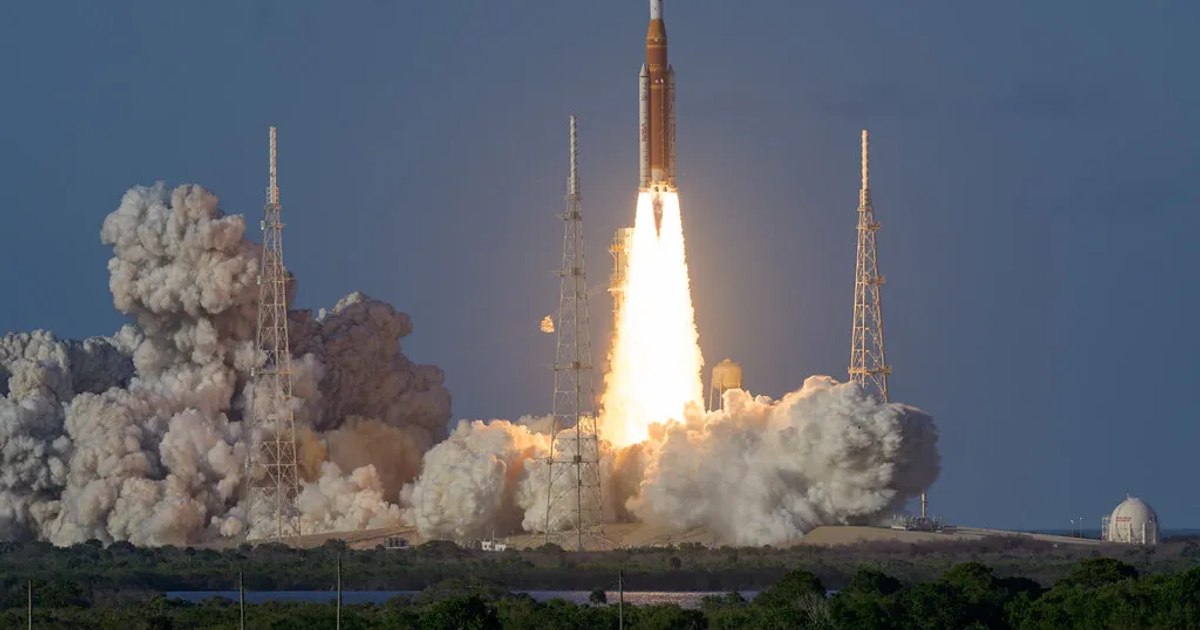
NASA’s Artemis II lunar rocket launched Wednesday evening, carrying astronauts to the moon for the first time in nearly 54 years.
The rocket is currently in orbit around Earth and will remain there until Thursday, when it will perform the translunar injection maneuver, which will propel it on the rest of its roughly 240,000-mile (about 386,000 km) journey to the moon, The Guardian writes.
Aboard the Orion capsule, the four astronauts immediately began procedures to assess how the spacecraft handled the 17,500 mph (approx. 28,000 km/h) ascent to orbit.
Flight controllers in Houston confirmed that all four solar panels, essential to continuously power the capsule for the duration of the mission, were operating successfully.
It is the first time since the Apollo 17 mission in December 1972 that humans have left low Earth orbit.
“The nation and the world have waited a long time for us to do this again”veteran NASA astronaut and Artemis II mission commander Reid Wiseman told reporters at the Kennedy Space Center on Sunday as the crew of three Americans and one Canadian arrived for pre-launch quarantine.
Communication problems
The launch wasn’t completely without its problems, however. Shortly after the rocket took off, communications between the four crew members on board the Orion capsule and NASA’s control center were temporarily interrupted, according to Agepres.
The crew could hear the voices of the mission control team, but they could not hear the astronauts, NASA Administrator Jared Isaacman said in a press conference.
“Communication with the crew has been restored. We are working to resolve this issue and will keep you updated”Isaacman said.
Ten days flight
Their test flight, lasting 10 days and not landing on the moon, is a mission full of important milestones. Two of the crew members, NASA’s Christina Koch and Victor Glover, will become the first woman and first black person, respectively, to reach cislunar space, the area between Earth’s orbit and the Moon.
The fourth crew member, Jeremy Hansen of the Canadian Space Agency, will become the first non-American to accomplish the same.
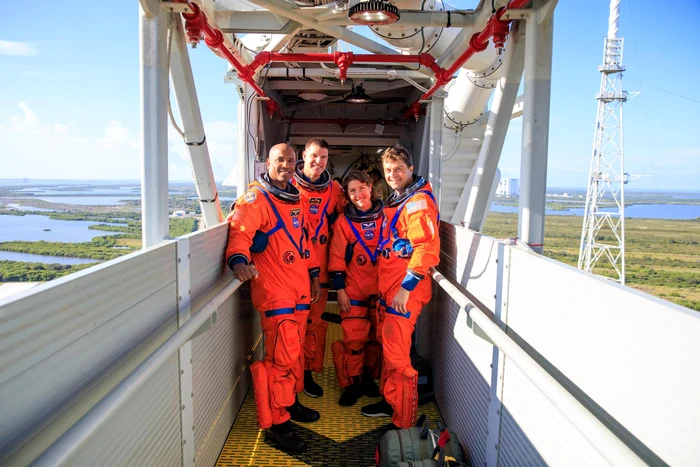
As a whole, the Orion capsule of the Artemis II mission could take the crew further from Earth than any other humans in history.
The astronauts are expected to reach more than 4,600 miles (7,400 km) beyond the far side of the Moon on the sixth day of the flight, and nearly 253,000 miles (407,000 km) from home, surpassing the April 1970 record of 248,655 miles (400,000 km) set during the Apollo 13 mission, which was plagued by a malfunction.
