
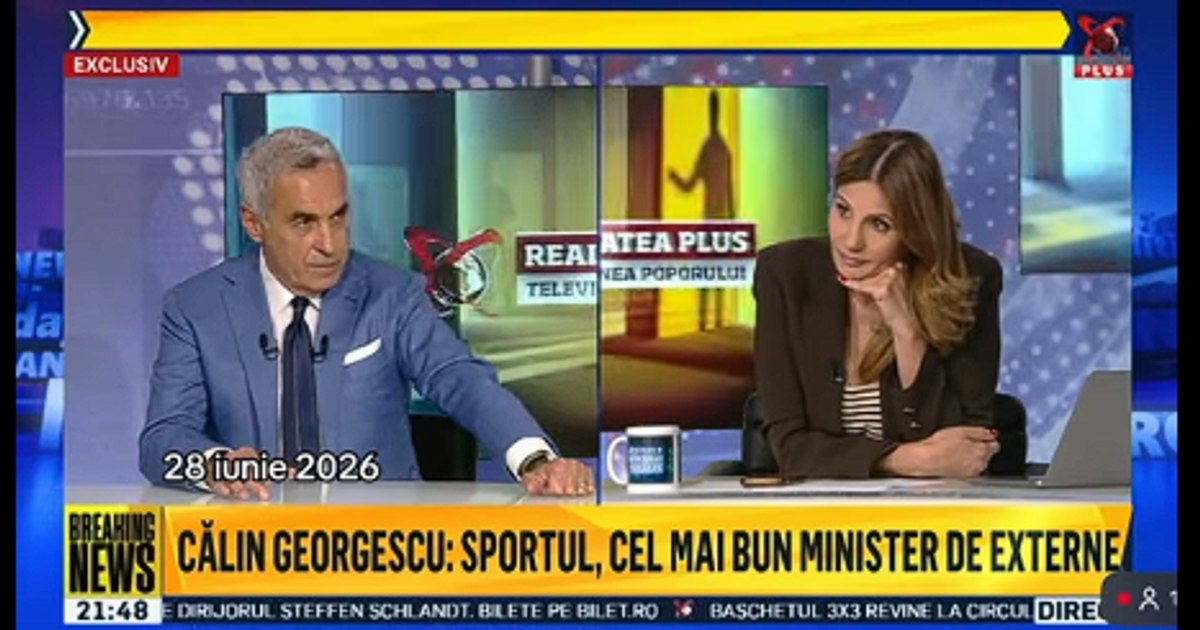
The recent dispute between Călin Georgescu and Anca Alexandrescu, in the Realitatea Plus studio, should not surprise anyone considering the dynamics of relations between the so-called “sovereignists”. In such a setting, visibility weighs more than coherence, and alliances last only as long as interests coincide. Political science professor George Jiglău explains for “Adevărul” the mechanisms that invariably lead to such ruptures.
A known precedent, but a more unstable context
According to George Jiglău, the Romanian political scene has gone through episodes of heightened volatility, but the current context is more difficult to manage.
“This political area, not only in Romania, but in any party system, is characterized by a very high volatility. We have gone through such episodes before, maybe not at the intensity of the last two years, but the closest precedent remains the PPDD of 2012. And then we were talking about a formation located in a conservative area, which claimed part of the PRM legacy. The difference is that today’s actors are much more professional than Dan was Diaconescu and, probably, even more numerous, which raises additional problems”, explained George Jiglau.
Visible cracks since the beginning of the electoral cycle
The idea of a unitary “sovereignist” front is, in George Jiglău’s opinion, rather an external perception. Tensions have been visible for some time, being evident during last year’s presidential elections.
“The fragmentation within this political front, as far as it ever existed as a coherent front, became visible since the resumption of the electoral cycle in 2025. It was obvious then how difficult it was for Călin Georgescu to accept the fact that he was no longer the main candidate. The episode with George Simion and Anamaria Gavrila, when they appeared together as potential candidates, illustrated this internal tension, as was also seen when Simion and Georgescu went together to vote, with no real coherence between them. This lack of unity emerged from the statements and body language in the public space. At certain moments, Simion was presented as a kind of disciple or follower, but this relationship was never stable or accepted by all the actors involved. At other times, a clear distancing was seen, including in relation to other political figures associated with the same current. was obviously limited”emphasized George Jiglău.
The logic of a space dominated by competition for visibility
For George Jiglău, the conflict is not accidental, but the direct result of a political space in which each actor claims its central position.
“It is clear that we are talking about political actors strongly focused on their own visibility, with an accentuated personalist profile, in which each one claims their main role. The appearance of new public figures or the expansion of the exposure of existing actors inevitably generates tensions, because each of them tries to occupy the central position in a limited political space”. explained George Jiglau.
In the absence of a solid ideological framework and internal arbitration mechanisms, competition becomes permanent and fluid.
“There is not, in reality, a stable internal structure or a unitary ideological background. On the contrary, it is a space characterized by permanent competition for visibility and influence, in which alliances are fluid and conjunctural. This dynamic is also reflected in the way the parties of this spectrum evolve in Parliament. There are constant ruptures, separate groups and reconfigurations, including around figures like Diana Şoșoa or other similar personalities, which confirms the lack of coherence A common factor of these actors is their strong personality. None easily accepts to be in a secondary position. In the absence of this positioning, conflicts and fragmentations inevitably occur.”the professor of political science emphasized.
Exchange of lines live between Călin Georgescu and Anca Alexandrescu: “You were completely wrong!”. The moderator, irritated: “Are you suggesting that I have no character?”
Parliament as a reflection of fragmentation
This dynamic is also found in parliamentary functioning, where reconfigurations and ruptures are frequent. New groupings and repositioning around figures like Diana Șoșoacă constantly appear, which confirms the lack of coherence of the entire political spectrum.
“However, at the level of the electorate, things work differently. There is a relatively stable segment that responds to the same type of messages, regardless of the person who conveys them. Whether we are talking about Călin Georgescu, George Simion, Diana Șoșoacă or other similar figures, the electoral core remains largely the same, not being sensitive to differences in style or variations in discourse. The differences between these actors are of form rather than substance, the ideological content retaining many points in common even if the mode of expression differ significantly, which explains why the electoral base does not change radically from one actor to another”, explained George Jiglau.
This overlapping electorate explains why internal competition inevitably becomes electorally destructive. When multiple candidates address the same pool, the vote is split.
The real stakes of domestic competition
In presidential elections, this fragmentation can directly influence the final outcome, as entering the second round depends on the concentration of the vote.
“In a presidential context, this fragmentation becomes decisive. If several actors in the same space compete simultaneously, the risk is that the vote will be split and none will reach the second round. Therefore, the real stake is the imposition of a single central representative of this electorate, and the competition for this status explains to a good extent the conflicts we see now, conflicts that are more about positioning than about real ideological differences”. emphasized George Jiglau.
What started the scandal
We remind you that everything started from an interview given by Călin Georgescu in the show “Coulisele Statului Paralel”, broadcast by Realitatea Plus and moderated by Anca Alexandrescu. The discussion initially evolved in an ordinary register, but quickly escalated when the moderator admitted that she supported Adrian Veștea for the position of prime minister, reasoning that she did it to avoid the Ilie Bolojan option.
The ÎCCJ postpones the debates in the case of Călin Georgescu and Horațiu Potra until August 5. What the former presidential candidate said when he left the court
Călin Georgescu rejected this justification: “Yes, you’re completely wrong. It’s a complete misjudgment. Stop repeating this, because it’s an approach that completely misrepresents political reality.”
Later, Georgescu accused the station of censoring a public call to parliamentarians not to support the Veștea government, which he called “the illegitimate prime minister of the non-existent president”.
“At that time I was censored by your television, as I sent an extremely clear public message to the parliamentarians, warning that voting for that government is an act of betrayal of the country’s interests.” said the former presidential candidate, while Anca Alexandrescu rejected the accusation, stating that she was not present at that show.
The exchange of words intensified after Georgescu accused Anca Alexandrescu of supporting Nicolae Ciucă.
“Prior to November 24th, as far as I know, you supported that soldier, who has since defected, and this kind of posturing raises legitimate questions about consistency and how these public supports are built,” said Georgescu. In reply, Anca Alexandrescu explained that she made shows with all the relevant candidates, including Marcel Ciolacu and George Simion, without this implying political support.
On Monday, Realitatea Plus announced that it will no longer broadcast Călin Georgescu’s appearances until a public apology is presented. The station referred to his statements regarding the motivations of the audience and conveyed that he assumes the decision even at the risk of losing the audience.
