
In the absence of real negotiations with the Government and an urgent correction of the salary law, more than 60% of the health workers are ready to leave the system, and the unions are threatening a general strike, warning that the current grid and cutting allowances are throwing the sector into collapse.
According to the “Health Solidarity” Federation in Romania, a consultation of employees in the health field evaluated the expectations of the personnel in the system regarding the future changes in the salary law and their impact on the stability of the human resource in health.
The figures show that over 60% of health workers are considering leaving the system if the wage law is not corrected.
Răzvan Gae, vice president of the Sanitas federation, explained for “The Truth” that despite the survey of colleagues at the Federation “Health Solidarity”the Ministry of Labor has not yet contacted the trade unionists to negotiate the new wage bill.
“The Sanitas Federation asked the court for a presidential order to postpone the adoption of the salary bill until the installation of a government with full powers. However, the request was postponed by the court because the Government did not make all the necessary documents available to the Justice. In addition, the Ministry of Labor, headed by Dragoș Pîslaru, did not call the union to negotiations, although the labor conflict had already been triggered. The Federation maintains the warning that it will go on general strike next week if there is no negotiation.
The current salary hierarchy is not correctly established neither between the different budget categories nor within the health system. We emphasize that the medical assistant is essential, being the “eyes and ears” of the doctor, especially in the operating room, where he takes care of patients operated on or about to be operated on. However, this main role is not sufficiently recognized in the salary scale.
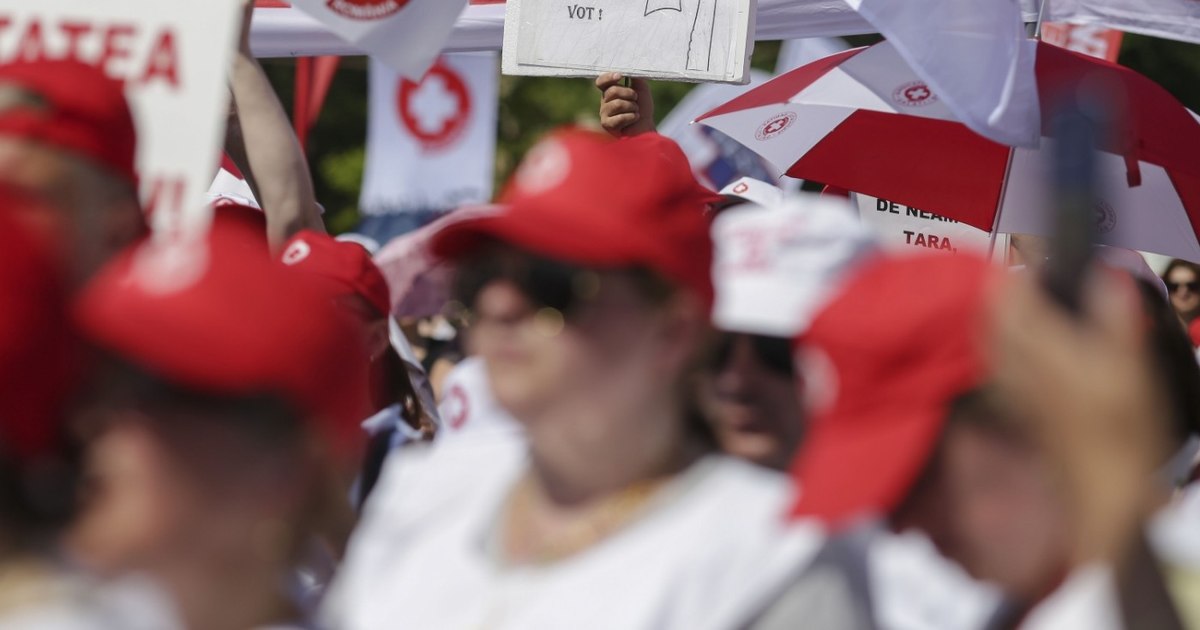
Most of the participants in the protests (of the approximately 15,000 people, of whom at least half are nurses) are nurses, orderlies, stretcher bearers and TESA staff. The movement was also joined by the Multidisciplinary Society of Resident Doctors, pharmacists (through the Promedica union, originally affiliated with a doctor from Craiova, but who came to Sanitas due to the lack of action) and other professional categories, such as physiotherapists, psychologists and biologists. We collected all their suggestions and proposed a grid that would ensure a fair redistribution, corresponding to normal working conditions”said the vice president of Sanitas.
He explained the need for the increments and allowances cut by the new bill.
“To understand what normal working conditions mean for a nurse, one must mention the permanent risk of accidents with sharp and stinging objects (needles, broken ampoules, scalpel blades). To this is added psycho-social stress, burnout caused by the high volume of work, lack of staff, the impossibility of unlocking positions and overwork in hospitals, where work is at the minimum or even below the minimum, especially during periods with many medical leaves or rest. The activity in ture of doctors destroys the body’s normal biorhythm and, according to some scientific studies, can increase the risk of cancer by 15-20% due to accumulated wear and tear. This information comes from OSFH and European unions, because in Romania there is no capacity to carry out such research”said the trade unionist.
Wave of strikes and blocked activity in courts and prosecutor’s offices due to the new Law on unitary wages
What are the doctors’ claims
The unions of doctors and health personnel have categorically rejected the draft of the new salary law, launched in public debate in May 2026 by Minister Dragoș Pîslaru, and their grievances are focused on several fundamental claims related to the calculation formula, the maintenance of incomes and the internal equity of the system.
The claims did not remain only at the declarative level, but took shape in forceful actions. Over ten thousand health workers took to the streets to protest the law, and the SANITAS Federation threatened to launch a general strike after June 21, 2026 if the demands were not met, with a Japanese hospital strike announced as further pressure.
First, unions challenge the very mathematical basis of future wages. They demand that the reference value used in the calculation be set at 4,325 lei, and not at the 4,100 lei originally proposed by the Ministry, because any difference at this level dramatically affects the entire grid. At the same time, they request correct and fair salary coefficients, which faithfully reflect the hierarchies and responsibilities in the public system, accusing that the current grids in the project are not well laid out and create major imbalances, sometimes favoring management positions to the detriment of senior medical staff or with direct clinical responsibilities.
Another vital claim concerns the preservation of the increments, which in the initial version were threatened by a general ceiling at 20% of the salary fund. Unionists are specifically calling for the shift pay to be kept at 15% and the weekend pay at 100%, arguing that eliminating or reducing them would lead to a dramatic drop in real incomes. Incidentally, the main grievance that has generated the fiercest reaction is that, according to their calculations, more than sixty percent of health workers would have lower incomes than they do now, despite officials’ promises that no one would lose out, because the removal of the cap actually hides massive cuts in the bonuses that make up a substantial part of the real pay of doctors and nurses.
In addition to the raw financial aspects, unions raise structural issues of equity. They demand that the TESA staff, i.e. the technical, economic, social and administrative staff, be included in the same annex of the law as the medical staff, in order to eliminate the current salary discriminations. Also, the National Law Enforcement Union demanded the elimination of unjustified salary differences between professions with similar training, such as between biologists, chemists and other categories in the health system. Dissatisfaction was so deep that the SANITAS Federation demanded the withdrawal of the document, which it considered unacceptable, unfair and deeply inappropriate, and the Federative Chamber of Doctors’ Unions asked President Klaus Iohannis not to promulgate the law and to send it to the Constitutional Court for a constitutionality check.
