
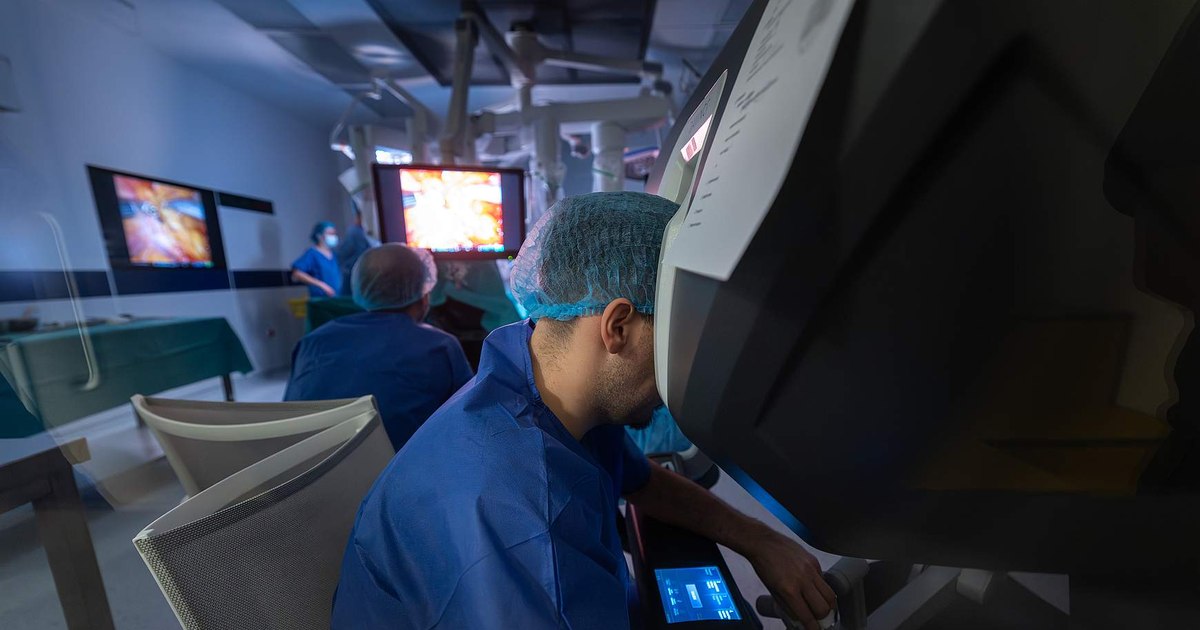
For patients diagnosed with localized prostate cancer, surgery not only means removing the tumor, but also protecting, as much as possible, the quality of life after treatment.
Băneasa Tumor Center Hospital, part of Leventer Medical Group, marks a first in Romania by performing a robotic radical prostatectomy with the synchronous use of the NeuroSAFE technique. This advanced procedure allows rapid intraoperative verification of resection margins and helps the surgeon make real-time decisions to preserve important nerve structures.
The intervention was carried out at the end of June, in a 66-year-old patient, diagnosed with localized prostate cancer by Fusion prostatic puncture-biopsy. The operative team was formed by Dr. Alexandru Leonida Goman, coordinator of the hospital’s urological surgery department, Dr. Alin Almășan and Dr. Alexandru Zamfira, together with the ATI team coordinated by Dr. Alexandru Gîrleanu, and the NeuroSAFE histopathological examination was performed by Dr. Alexandra Vilaia, pathologist.
Baneasa Tumor Center Hospital is a private hospital superspecialized in oncological pathology and minimally invasive surgical treatment, especially by robotic approach. In this case, the integrated structure of the hospital, bringing together specialized surgical teams, imaging, pathological anatomy and ATI, made it possible to carry out a complex procedure, where the surgical decision was guided directly in the operating room by the rapid histopathological result.
After releasing the surgical piece, the prostate was extracted in a special specimen bag, of the Endo-Bag type, and immediately sent to the pathological anatomy laboratory of the hospital, where it was analyzed using the NeuroSAFE – Neurovascular Structure-Adjacent Frozen-Section Examination technique. This is an advanced technique used during radical prostatectomy, designed to balance two essential goals: complete tumor removal and preserving, as much as possible, the patient’s quality of life after surgery.
Histopathological result in 40 minutes, right during the operation
In the case of this patient, the surgical team received the result approximately 40 minutes after the extraction of the surgical piece: the resection margins were negative in the analyzed segments. Thus, the intervention was successfully completed, marking the first robotic radical prostatectomy in Romania performed with the synchronous use of the NeuroSAFE technique. The patient had a favorable postoperative course and was discharged on the third postoperative day without incident with an uncomplicated postoperative course.
“For the patient, such an approach means more precision during surgery and more attention to functional recovery after treatment. The fact that we can check the resection margins in real time helps us keep the right balance between oncological safety and protecting important nerve structures,” he says Dr. Alexandru Leonida Goman, Coordinator of the urological surgery department at Baneasa Tumor Center Hospital.
How NeuroSAFE helps preserve nerve structures
Traditionally, the surgeon has to decide, before or during the operation, whether to perform a wider resection, partially or totally sacrificing the nerves around the prostate for oncological safety, or whether to try to preserve these structures, with the risk of positive surgical margins. The NeuroSAFE technique reduces this uncertainty through a histopathological analysis performed right during the intervention, while the patient is still under anesthesia.
Basically, the surgeon starts by preserving the neurovascular bundles, structures important for erectile function and, in part, for urinary continence. After the prostate is removed, the edges of the piece are snap-frozen, sectioned, and analyzed under a microscope. If no tumor cells are identified at the margins, the surgeon can complete the operation knowing that the nerves have been preserved in oncologically safe conditions. If cancer cells are detected, the team is alerted immediately and the resection can be extended in that area to increase the chances of complete removal of the tumor.
More precision, impacting functional recovery
The benefits of this technique are important both from the perspective of oncological safety and functional recovery. By immediately checking resection margins, NeuroSAFE helps confirm complete removal of tumor tissue and can reduce the risk of subsequent adjuvant treatments. At the same time, it allows the most precise preservation of the nerve structures, with an impact on erectile function and on the recovery of urinary continence.
Recent clinical data, including from the UK NeuroSAFE PROOF trial (published March 2025), support the potential of this technique to improve functional outcomes after radical prostatectomy, particularly by reducing unnecessary nerve sacrifice when surgical margins are negative.
This intervention shows how the integration of robotic surgery with rapid histopathological analysis can bring more precision in the treatment of localized prostate cancer. For patients, such an approach may mean better control of oncological safety and increased attention to functional recovery after treatment.
More information about robotic surgery interventions at Baneasa Tumor Center Hospital can be found here: baneasahospital.com
