
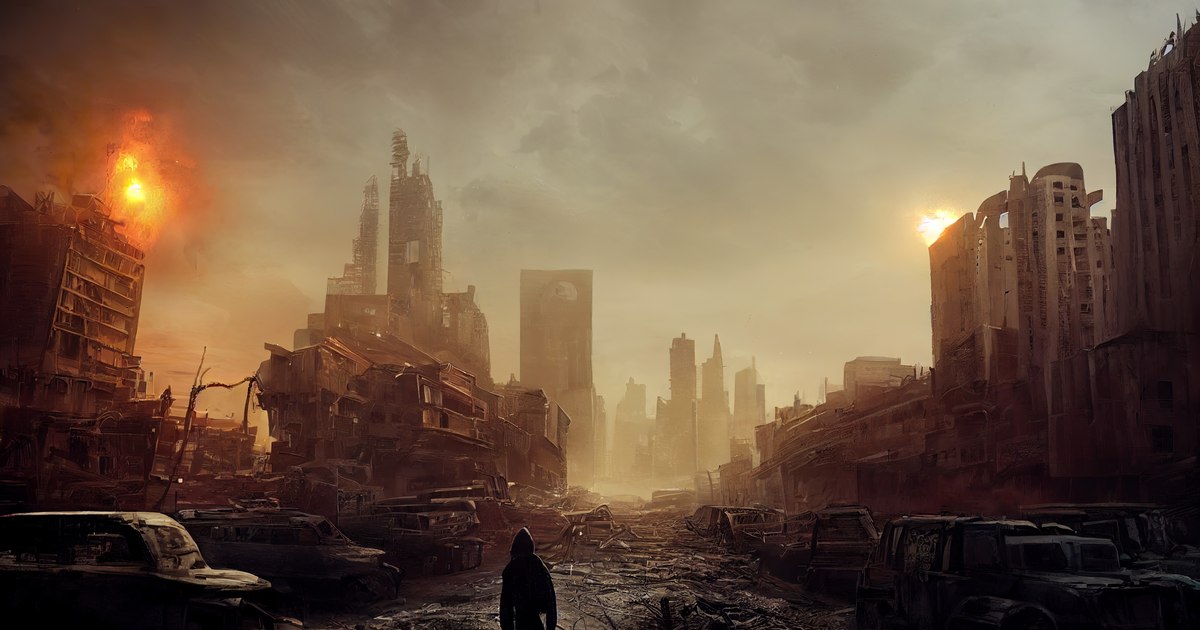
A group of researchers tried to answer one of humanity’s oldest questions: how long will the human species exist? Using a controversial statistical model known as the ‘Apocalypse Argument’, they estimated that humanity could disappear within the next 17,100 years.
The theory is not based on wars, pandemics or natural disasters, but on mathematical probabilities. The model is based on the idea that people living today represent a random sample of all people who have ever existed and will ever exist, reports the Daily Mail.
An estimated 117 billion people have been born on Earth throughout history. Starting from this number, the researchers calculated that the total population of the human species could reach about 2.34 trillion people.
At the current birth rate, this threshold could be reached in about 17,100 years.
The hypothesis was proposed by astrophysicist Brandon Carter and later popularized by philosopher John Leslie.
The theory is based on the Copernican principle, according to which humans do not occupy a privileged position in the universe. Applied to human history, this principle suggests that the present generation should be neither very near the beginning nor very near the end of the species’ existence.
Because of this, proponents of the model believe that there is a 95% probability that the total number of humans that will ever exist will not significantly exceed the calculated estimate.
However, many specialists dispute the model’s conclusions, arguing that it oversimplifies reality.
Among the ignored factors are technological development, artificial intelligence, advanced medicine or the possibility of colonizing other planets, elements that could radically change the future of human civilization.
In fact, even the authors of such studies emphasize that it is not a concrete prediction regarding the end of the world, but a statistical exercise based on certain mathematical assumptions.
Separate research published in May by researchers at the University of Milan analyzed a hypothetical scenario in which environmental degradation drastically reduces Earth’s ability to support the current population.
The model indicated that the global population could halve by 2064 to about two billion people. However, the authors stated that the results represent only a mathematical simulation and should not be interpreted as a forecast.
In conclusion, although such calculations draw attention with their spectacular conclusions, the scientific community emphasizes that the future of humanity depends on numerous factors that are impossible to predict with accuracy, from the evolution of technology to the ability of societies to face global challenges.
