
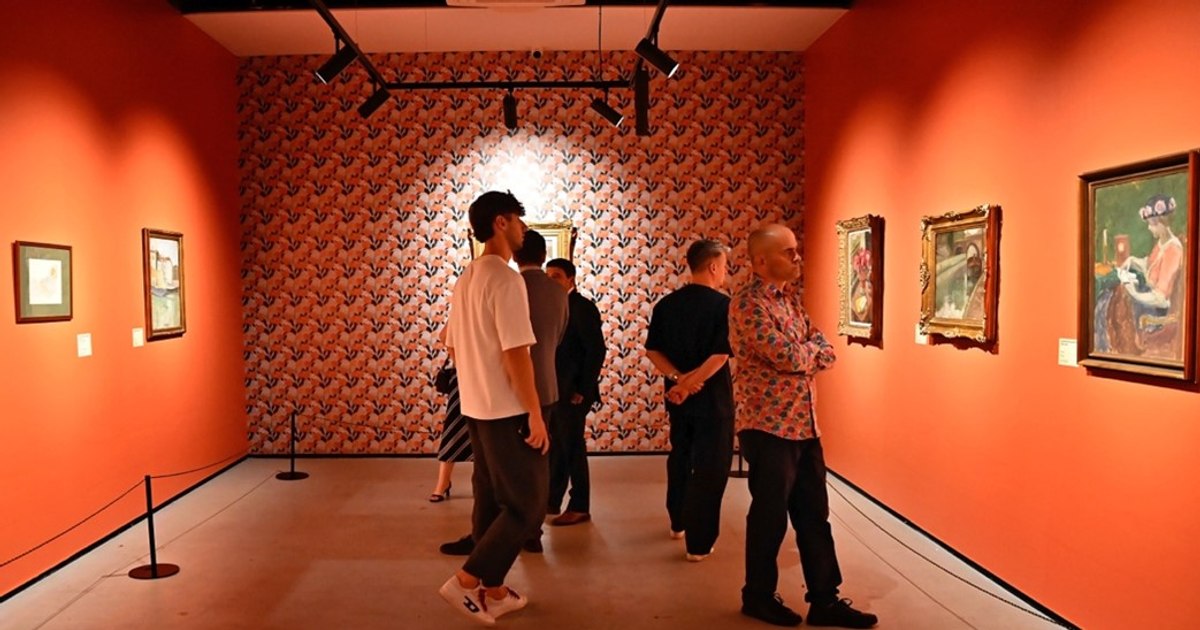
The capital has transformed this autumn into a true cultural destination. Until December 14, at Art Safari, anyone can travel through the Paris of Pallady and Matisse, in the exhibition “Paris Pallady”.
A visual essay that invites art and beautiful lovers in an artistic foray through the city of lights, in the atmosphere of the beginning of the 20th century, without leaving Bucharest or the country.
From the beginning of the school in Barbizon and until the end of the Paris school, most of the Romanian artists – from the founders of the school Nicolae Grigorescu and Ioan Andreescu, to the most famous representative of Romanian art, Constantin Brâncuși – have studied, exposed and were active in the country and in Paris.
The French capital represented not only the crucible in which the Romanian art was defined as a national art (the artistic youth society, the one that modeled the entire Romanian artistic scene for half a century, was founded in Paris, in 1901), but also the landmark of aesthetic quality, of life experience and even of the artistic spirituality of the Romanian world.
“The great Paris was the cradle and the quality criterion of the art of little Paris. This is not just about the Paris of workshops and art schools, but about the unique essence of living and building intellectually, artistic, social and human in that unparalleled environment. The Romanian art is probably the most edifying in Theodor Pallady’s work (1871-1956), ”says Erwin Kessler, historian and art critic, interim director of the National Museum of Romania, who offered accompaniment to the” Paris Pallady “exhibition from Art Safari.

From engineering to painting
Theodor Pallady was born in Iasi, in a boyar family with roots in the Cantacuzino family. Although he initially chose the exact sciences, studying engineering in Dresden, he later decided to change his route. He chose to study art in Paris, under the guidance of Gustave Moreau, having famous colleagues such as Marquet, Rouault and Matisse, with whom he tied a life of life.
Pallady lived and worked in Paris (three decades) and Bucharest. He instilled that unique “Air de Paris” in almost all his works, that Parisian state of the bourgeois being who aspires not to the terrestrial paradise, but to the urban paradise.
“This is the subject of the Paris Pallady exhibition. Despite the large number of works – over 100 – and the numerous documents that give the exhibition a historical, social and anthropological context, it is not a retrospective exhibition, but about a state – a phenomenological essay in which art not only depicts, not only a subject, but not a subject, Aspirated by the public through all the senses, not just the visual one, ”says Erwin Kessler.


What does Pallady’s Paris look like
Paris is the only paradise of Pallady’s inner life, the perfect shell, in which apparently good rituals are carried out – reading, watching the window, smoking and coffee. If Grigorescu and his descendants glorified the national ideal, the peasant idyllism and the heroism, opposite them, Pallady glorified the comfort of the Parisian or Bucharest urban interior, cloned after the Parisian.
“His work is feeding from the familiar air, and yet the extinguisher of the furnished rooms, with their standard-hot props: the window with wrought iron grille and soft curtains, with cheerful prints, the gray face, on which stand newspapers, books, flowers or fruits, the cellar, with the flowers, with the flowers, or It shows, most commonly, the only form of human life that interested the artist – an empty woman or about to bare, ”adds Kessler.
The exact sciences have left their mark on Pallady’s work, “which transforms bodies and places into functional, well-articulated, but visibly combined science scaffolding, of the Dresden Polytechnic, sheltered inadvertently in the symbolist lyrics of Paris.”

Friendship with Matisse
In an exceptional visual dialogue, the exhibition from Art Safari brings together both works done by Theodor Pallady (1871–1956) during the period spent in Paris, as well as pieces signed by Henri Matisse, borrowed from Musée de l’Onragerie and Musée Henri Matisse-Département du Nord. Visitors are thus invited to discover European modernity through the eyes of artists who have definitely changed art history.
The relationship between Pallady and Matisse was a special one, based on the same passion for interiors, female nude and modern reverie.
“The dialogue between Pallady and his friend, Matisse, by exposing (at art safari) a Woman with violin The latter, captures their common term in building the female attitude of reverie: Vermeer. The quiet ecstas of the Master of Delft in front of the unmistakable mystery of feminine dream with open eyes captures that unique emotional state capable of affectively investing the whole environment in which it propagates. Modernity is thus revealed not only at the level of artistic means, but also in the much deeper layer of indefinite experiences. The intimate atmosphere, the lost gaze, the equal light entering the window – all these become common elements, but each of the artists keeps their own visual language, ”notes Kessler.

The exhibition “Paris Pallady” from Art Safari is the perfect invitation for a Cultural City Break, without a plane ticket, directly in the center of the capital. It can be visited until December 14, at the Dacia-Romania Palace, on Lipscani 18-20, from Thursday to Sunday between 12: 00-21: 00.
