
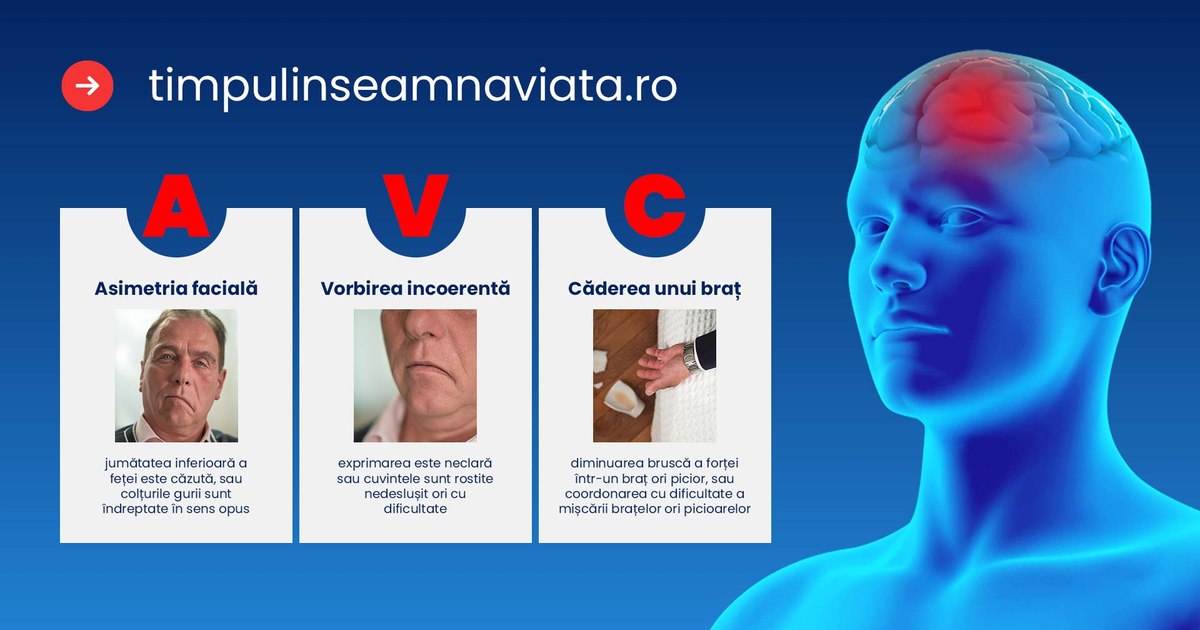
Stroke remains one of the most serious medical emergencies in Romania, with a significant impact on families and communities. In the face of such a widespread health problem, correct information becomes a key element. The “Time is Life” campaign emphasizes an essential truth: every minute counts when the brain is deprived of oxygen. How we react in the first moments can depend on a person’s recovery or even their life.
A public health problem ignored for too long
In Romania, it is estimated that between 60,000 and 70,000 people suffer a cerebrovascular accidentand approximately 55,000 of these cases are ischemic forms. In such situations, blood flow to a part of the brain is blocked, which causes rapid and irreversible damage if the patient does not receive timely treatment. Behind the numbers are ordinary people. Parents, siblings, grandparents or friends who can see their lives changed in an instant. Many of them may have a chance of almost full recovery if stroke symptoms they would be recognized in time, and medical intervention would be initiated within the first four and a half hours.
In this context, public education becomes vital. The right information can make the difference at critical moments, when every decision must be made with maximum speed and responsibility.
Signs you can’t ignore
To recognize in time signs of strokeit is essential to understand the main manifestations. Doctors describe three warning signs that anyone can spot without medical training. Facial asymmetry, when the smile suddenly becomes crooked or a cheek appears droopy, is often the first clue. Speech disorders are another major sign. If the person can’t slur words, slurs, or seems disoriented, it’s very likely they’re having a stroke. The third common symptom is sudden weakness in an arm or leg. In many cases, the person is no longer able to lift their limbs or they “drop” uncontrollably.
In the face of these manifestations, the reaction must be immediate. A simple one call 112 it can save lives and significantly limit brain damage. The coincidence of the moment
recognizing symptoms and getting to the hospital can mean the difference between a full recovery and permanent disability.
Time Trial: The first four and a half hours
“We want people to understand that time is life. In the face of a stroke, every minute lost means a smaller chance of recovery. Calling 112 is the first gesture that can make the difference between a normal life and one changed forever,” explains Liliana Curea, representative of the ALIA Association. Her statement sums up one of the most important medical truths about stroke.
The therapeutic window in which the patient can benefit from specialized treatments is limited. The first four and a half hours is how long the intravenous thrombolysis procedure can dissolve the clot blocking blood flow to the brain. The faster the intervention, the greater the chances of recovery. Detailed information and other educational resources can be found on the official platform www.timpulinseamnaviata.ro, where the campaign presents in an accessible way the steps that any witness of a possible stroke must follow.
The impressive evolution of the Romanian medical system
Romania has made significant progress in the last decade in terms of emergency treatment for stroke. If in 2015 there were only 14 hospitals capable of performing intravenous thrombolysis and three mechanical thrombectomy centers, today the system looks completely different. Prof. Dr. Cristina Tiu, AP acute stroke national coordinator, points out that, thanks to the efforts of the Romanian Society of Neurology and the Ministry of Health, there are now 49 hospitals that can perform thrombolysis and 13 centers specialized in mechanical thrombectomy.
Progress is not only administrative, but can be seen directly in the number of patients treated. In the first nine months of this year, over 3,200 thrombolysis and over 1,200 thrombectomies were performed nationwide. These figures indicate a medical system that has become more prepared and able to offer real chances to patients experiencing a stroke. For complete information about the campaign and additional resources, readers can again consult the www.timpulinseamnaviata.ro platform.
Vasiliki Tsagkaraki, General Manager of Boehringer Ingelheim Romania, reminds that the role of medical institutions and pharmaceutical companies is to be reliable partners for the health system. Public education, innovation and the availability of effective treatments are becoming mandatory elements in a society that wants to reduce the impact of stroke on the population. Knowing the symptoms and taking quick action form the basis of this fight.
The power of information in the digital age
This year, the “Time means life” campaign chose the online medium to reach as many Romanians as possible. The series of videos, information messages and educational resources have the role of transforming the digital space into a prevention tool accessible to all. In situations where the first few seconds can save lives, it is essential that the correct information circulates quickly. The official platform www.timpulinseamnaviata.ro offers both clear explanations about the symptoms and recommendations on the correct way to react.
Recognize the signs. Act quickly. Time means life.
Stroke is a medical emergency where every moment counts. The right education, recognizing the symptoms and calling 911 right away can turn a potentially devastating event into a real chance for recovery. Each of us can become a savior when we understand the importance of quick reaction.
Recognize the signs. Act quickly. Time means lifeah.
