
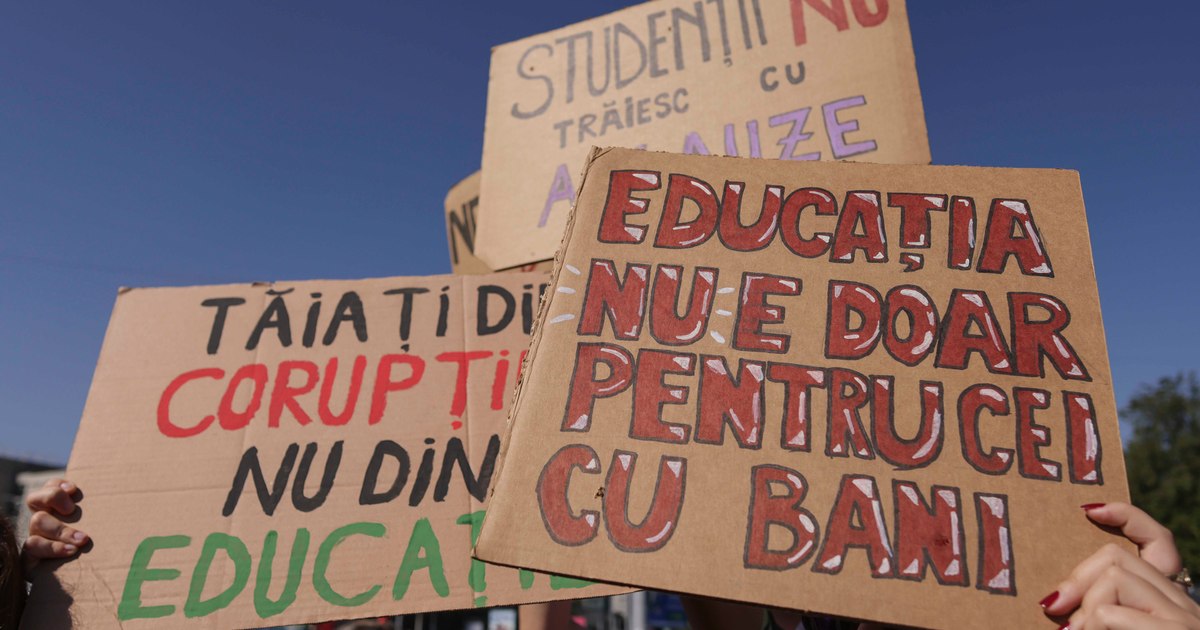
The new salary law, under discussion at the Government level, brings a major change in terms of teacher remuneration, which may cause experienced teachers to retire earlier, claims trade unionist Alexandru Mihai Mihalcea, for “The Truth”.
Its analysis comes in a context marked by debates on the salary scale, also considered as “too compact” by Marius Nistor, the president of the “Spiru Haret” Federation of Education Unions.
According to the union leader, education will not be attractive, because the difference between the salary entering the system and the salary leaving the system will be very small.
“At the moment, through this unified salary bill, the provisions of Ordinance 56 are canceled in their entirety, and the beginner’s salary will be 1,000 lei lower. Plus, we are no longer discussing any kind of incentive for colleagues who have seniority and teaching degrees. For 40 or so percent of the education staff, the income freezes, the grid is strongly compressed, so the difference between the salary entering the system and the salary exit from the system will be very small, which will continue or will continue to maintain the lack of attractiveness of the educational field”said Marius Nistor on TVR Info, the other day.
Furthermore, the Government continued its efforts to compress the grid by announcing under pressure from the teachers that it would keep the management allowance, which would still be set at a fixed amount of 400 lei gross for all teachers, regardless of seniority, instead of the old percentage calculation system, which allowed higher salaries for experienced teachers.
Trade unionist Alexandru Mihai Mihalcea emphasizes that the proposal of 400 lei is not a real compromise, but a unilaterally imposed measure, given that negotiations on this topic had already been conducted previously.
“The recent proposal is that teachers should continue to receive the management allowance, but in the form of a fixed amount of 400 lei, and the question that arises is whether this arrangement could be accepted by the teachers as a compromise. In reality, however, it is not a compromise, because the negotiations on this topic had already been carried out. The authorities again came to the conclusion that the management is indispensable, but the Government did not agree that it should remain a percentage of 10% calculated on the full salary, so they determined that 400 lei is a fair amount for all teachers, regardless of seniority”said Alexandru Mihai Mihalcea.
The trade unionist compared the new amount with the old pay scale, showing that teachers with more experience received a higher allowance.
“On the old grid, teachers with more experience could even receive 600 lei, so for those with less than 20 years of experience, 400 lei may seem acceptable, but for more experienced teachers the amount is insufficient”explained Mihalcea. He warns that this disparity will breed resentment and discourage older teachers from continuing as principals.
The Education Unions announce the postponement of the general strike in pre-university education
Trade unionist: Elimination of wage progression, an objective of the Government
Another aspect criticized by Mihalcea is the intention of the authorities to eliminate any form of salary progression based on experience, which is reflected not only in the management allowance, but also in the entire salary scale. “What the authorities are looking for is, in fact, the elimination of any possibility of gradual or percentage salary increases, and it was precisely the previous dynamics that they disliked”said the trade unionist.
He explained that the new salary scales are extremely compact, so years of experience no longer have a significant impact on teachers’ earnings, which raises serious questions about the future of the profession. “As for the salary scales, they are now so compact that the experience of teachers no longer matters significantly, which raises the question of whether this measure will lead to a decrease in interest in the profession or, on the contrary, will stimulate young people at the beginning of their careers”said Alexandru Mihai Mihalcea.
According to the trade unionist, the answer is complex and essentially negative for both categories. Although the entry salary might seem more attractive to young graduates, the economic reality in big cities makes it insufficient. “The answer is that it will probably happen a little of both: the entry salary may seem more attractive, but in the current economy it is insufficient anyway, especially in big cities like Bucharest, Cluj, Iași or Suceava, where rents are far too high for a beginner to survive”explained Mihalcea.
On the other hand, experienced teachers who feel wronged may choose to leave the system. “On the other hand, experienced teachers, who feel wronged by the fact that they can no longer progress in salary commensurate with years of service, will ask for early retirement or look to migrate to other professions”warned the trade unionist.
Asked if experienced teachers could be attracted to the private sector, Alexandru Mihai Mihalcea answered that this possibility exists, but he emphasized that it is not necessarily a viable solution, and the mass migration of teaching staff would be a disaster for the public system.
“The question of whether experienced teachers could be attracted to the private environment remains open, but I do not think it is the case, because the private sector does not always offer better conditions; often, collaborations are based on service contracts through PFA or SRL, and stability is not guaranteed. Moreover, even if such a migration were to happen, it would represent a tragedy, because moving teachers from the public to the private system would turn education into a competitive space similar to corporations, which is not it is a desirable precedent, because it would affect both the continuity of the educational process and the relationship of trust between teachers, parents and students”concluded Alexandru Mihai Mihalcea.
